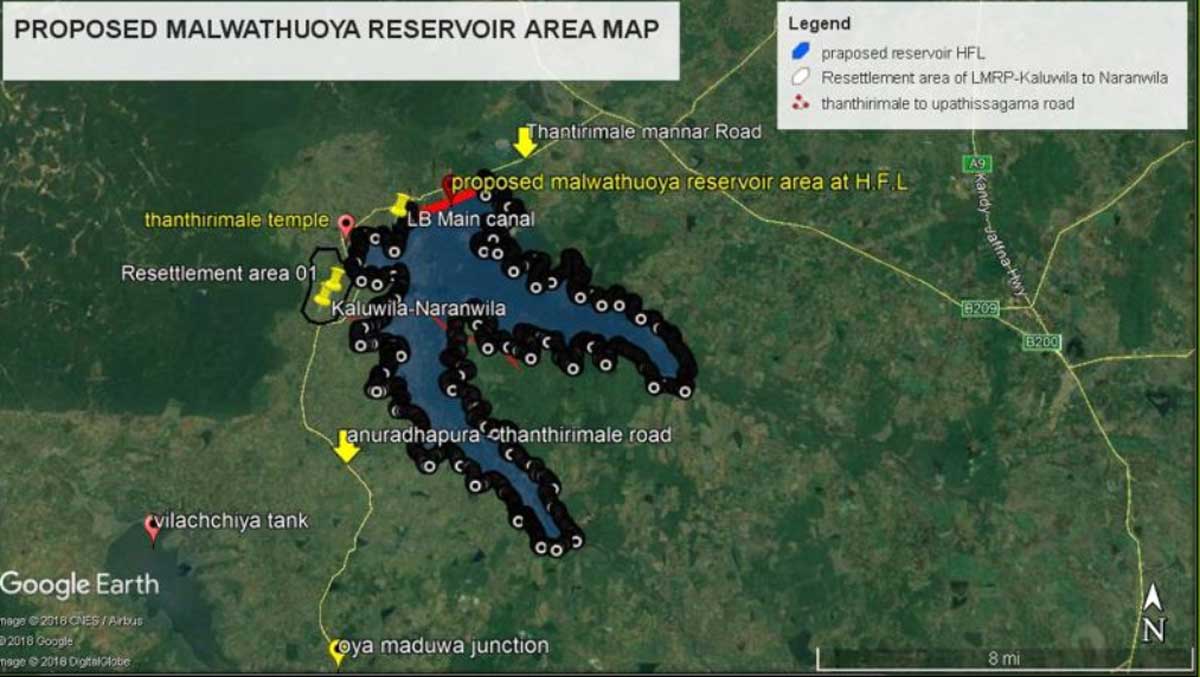
The Sri Lankan Cabinet has approved the resumption of the Lower Malwathu Oya multipurpose hydro power project, which had been suspended following the COVID-19 pandemic and a subsequent currency crisis. The crisis, which ultimately led to a sovereign default, was triggered by aggressive interest rate cuts aimed at stimulating economic growth.
Initial Cabinet approval for the project was granted on July 19, 2019, with an estimated cost of 22.9 billion rupees. A revised project proposal was submitted to the Cabinet in December 2025, reflecting a new estimated cost of 47.18 billion rupees.
This revision represents a 106.02 percent increase in the project’s cost in rupee terms between 2019 and 2025. The rupee’s value fell sharply during this period, with the exchange rate dropping from 176 to 308 rupees per US dollar following monetary policy decisions and tax cuts implemented in 2019 and 2020. These measures were introduced under the flexible inflation targeting framework in an effort to boost potential output.
Sri Lanka has experienced multiple currency crises since the end of its three-decade civil war, attributed to attempts to operate an inflation targeting framework without a fully floating exchange rate. The depreciation of the rupee during this period led to an estimated 74 percent inflation from July 2019 to November 2025.
For comparison, the US Consumer Price Index for All Urban Consumers (CPI-U) increased from 255.21 points in July 2019 to 324.36 in September 2025, marking an approximate 27 percent rise. Data for October is unavailable due to a US government shutdown. The United States also experienced significant inflation in 2021 and 2022 following its own rate cuts under a single policy rate system, contributing to rising public dissatisfaction and growing economic and political nationalism, including stricter immigration policies and increased import tariffs.
High inflation has made fiscal management increasingly challenging, as costs and budget deficits have become unpredictable. Unlike earlier periods when tax increases could effectively reduce deficits, the current environment requires complex statistical modeling to manage public finances. Sri Lanka’s budgetary challenges have intensified since the early 1980s as the rupee depreciated, despite the US bringing inflation under control by targeting the money supply with a floating exchange rate.