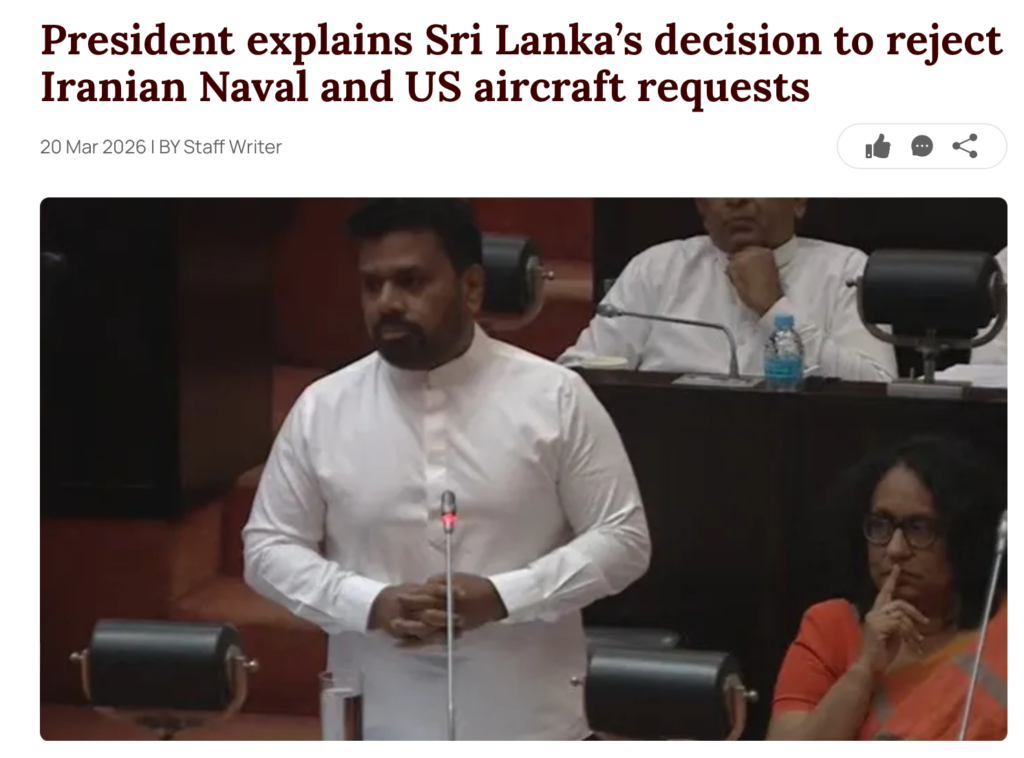
“President explains Sri Lanka’s decision to reject Iranian Naval and US aircraft requests” – Daily Mirror
In explaining the Government’s decision to deny access to United States fighter aircraft and Iranian naval vessels, President Anura Kumara Dissanayake has firmly positioned Sri Lanka within a framework of strict neutrality and non-alignment.
By refusing these requests, Colombo has opted for a path of strategic disengagement, deliberately seeking to avoid becoming entangled in an increasingly volatile geopolitical confrontation. This stance underscores the administration’s commitment to shielding the nation from the fallout of external power struggles, even as the domestic economy remains under intense pressure.
However, this approach what may be termed “negative neutrality” relies on distance and denial. It raises a broader question: is neutrality best preserved through disengagement, or could it be more effectively expressed through balanced engagement?
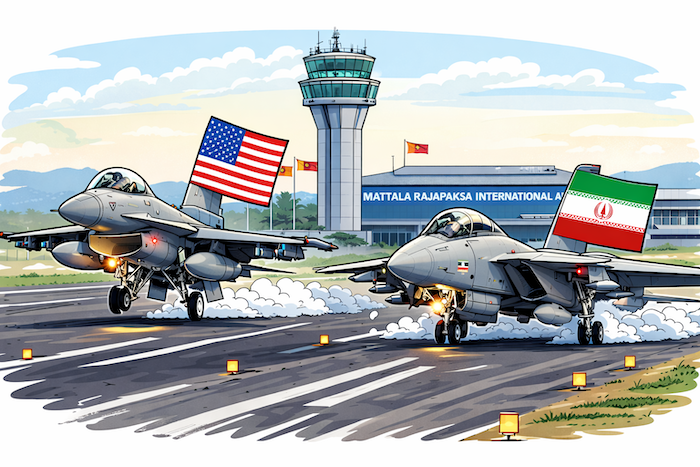
Neutrality does not inherently require stepping back from all actors. Traditionally, it can also mean engaging with all sides equally and without bias. In this sense, Sri Lanka had an alternative option. Rather than refusing access, the Government could have pursued a model of “positive neutrality” one rooted in balance. This could have involved permitting both United States and Iranian fighter aircraft to land at Mattala Rajapaksa International Airport under identical conditions, or allowing reciprocal naval access to strategic locations such as Trincomalee Harbour.
Such a strategy would shift Sri Lanka’s posture from passive avoidance to active equilibrium. Balanced engagement would not imply alignment with either side, but instead demonstrate an ability to manage relationships impartially. By enforcing clear, transparent, and time-bound conditions ensuring that no party could use Sri Lankan territory for offensive purposes—the country could uphold sovereignty while maintaining diplomatic openness.
The distinction is critical. Disengagement minimizes risk by staying out; balanced engagement manages risk by staying fair. The former is cautious and defensive, while the latter is confident and assertive. Refusing both parties is one way to remain neutral, but accepting both under equal terms is another arguably more dynamic expression of the same principle.
Sri Lanka, still recovering from its worst economic crisis in decades and operating with limited financial buffers, remains a lower-middle-income country striving to rebuild stability. Although foreign reserves have improved to around USD 7 billion in early 2026, they remain modest relative to import needs and external obligations . In this context, a strategy of balanced engagement could have carried tangible economic benefits. By permitting both United States and Iranian military aircraft to land at Mattala and allowing naval vessels to dock at Trincomalee Harbour under strict, neutral conditions, Sri Lanka could have generated much-needed foreign exchange through landing, servicing, and docking fees. Such a calibrated approach would not only reinforce neutrality but also provide a pragmatic revenue stream for a country still managing fuel shortages, external shocks, and ongoing fiscal pressures.
That said, balanced engagement is not without challenges. It requires strong institutional control, careful diplomacy, and the ability to withstand external pressure. Missteps could lead to misinterpretation or unintended escalation. Yet, complete disengagement also has its costs, including reduced strategic relevance and missed opportunities to exercise diplomatic leverage.
As global tensions deepen, Sri Lanka faces a defining choice in how it interprets neutrality. The Government’s current approach reflects prudence and restraint. But in an era where influence often lies in engagement rather than absence, a shift toward balanced engagement may better position Sri Lanka as a confident, sovereign actor navigating between competing global powers.