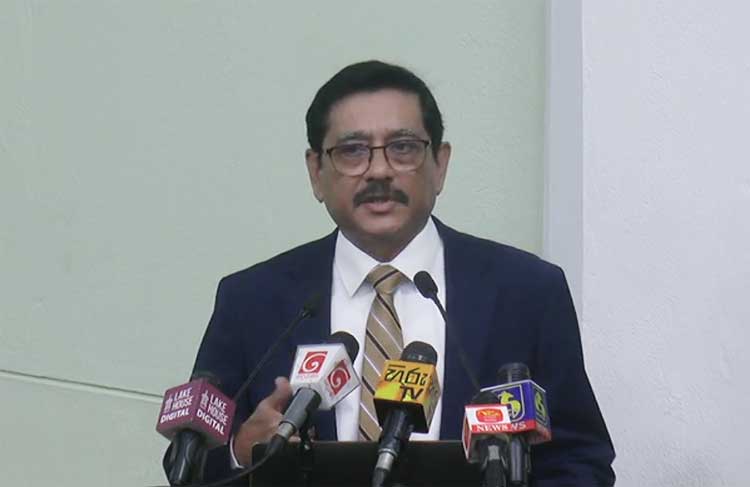
The Governor of the Central Bank of Sri Lanka, Dr. P. Nandalal Weerasinghe, firmly stated today that Sri Lanka does not require another debt restructuring. This statement was made in response to ongoing speculation, often referred to as the “28 phobia,” suggesting that the country might face repayment difficulties or require further debt relief by 2028.
Dr. Weerasinghe addressed these concerns while speaking as the keynote speaker at the Ceylon Chamber of Commerce’s launch of the Outlook 2026 report. Having played a pivotal role in the 2022 debt restructuring processes, he highlighted Sri Lanka’s longstanding commitment to meeting its financial obligations and provided data to demonstrate the sustainability of the current arrangements.
He described the fears of future restructuring as “completely misguided” and based on “misperception,” stating, “I have seen some of the, what I call the 28 phobia. People are talking about in 2028 there will be another restructuring, there will be a failure, the government won’t be able to meet the service payments. This story has been going around. I want to make it very clear here. Sri Lanka has had a strong reputation of willingness to meet the service obligation. What happened in 2022, we were willing, but we were not able because we didn’t have sufficient resources. That was the reason why we restructured.”
The Governor noted that 2025 included one of the highest post-restructuring payments, around US$3.935 billion, which comprised approximately US$1.3 billion in Central Bank obligations and US$2.6 billion in government payments. This was partly due to finalizing bilateral agreements and settling certain arrears. Looking ahead, he emphasized that annual service payments remain manageable, particularly as reserves continue to increase.
He shared the projected annual external debt service obligations (including Central Bank components) under the current restructuring terms as follows:
- 2026 – US$3.271 billion
- 2027 – US$2.537 billion
- 2028 – US$3.231 billion
- 2029 – US$3.386 billion
- 2030 – US$3.556 billion
- 2031 – US$3.493 billion
- 2032 – US$3.306 billion
“The point I am making here is that if we are building resources in the next couple of years of 8 to 10 billion, annual service is less than 3.5 billion,” the Governor asserted. “I don’t see any reason for even talking about another restructuring or another default — it is completely misguided, misperception.”
He cautioned that such speculation could create unnecessary doubt among investors and international partners, potentially undermining confidence despite the factual evidence of sustainability.
The Governor’s comments were made during a seminar focused on “Economic Growth in the AI and Digital Era.” He also praised the Ceylon Chamber’s independent report and discussed topics such as post-cyclone recovery, projected GDP growth of around 4.5% in 2025 and nearly 5% in 2026, and the significance of technology adoption for enhancing productivity. However, his primary message was to reassure investors by dispelling debt-related fears with concrete figures.
The Outlook 2026 report, produced by the Chamber’s Economic Intelligence Unit, offers a comprehensive forward-looking analysis.