A deeper correction could potentially push the index toward 18,500
Colombo – Sri Lanka’s stock market took a sharp hit this week as rising global tensions and surging oil prices triggered a wave of selling on the Colombo Stock Exchange, wiping out billions of rupees in market value and raising fresh concerns about the island’s fragile economic recovery.
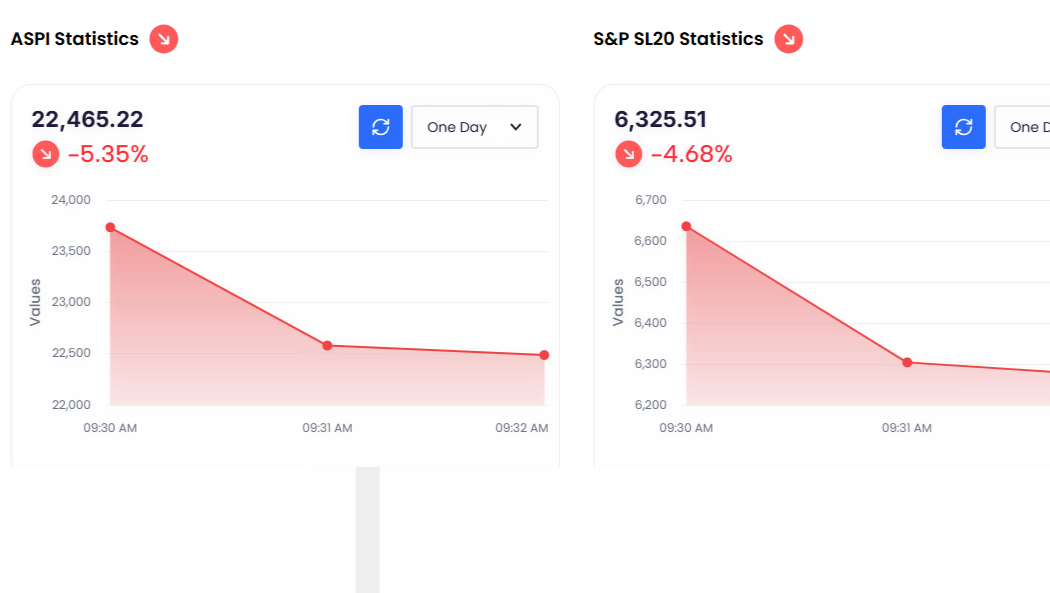
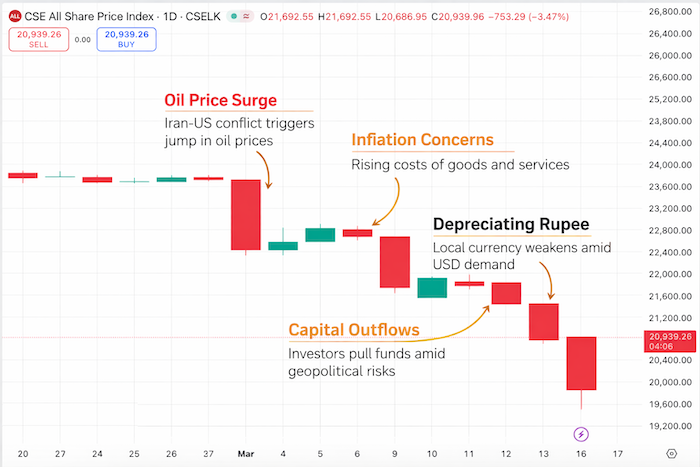
The benchmark All Share Price Index (ASPI) plunged more than 3% in a single trading session, sliding to around 20,950 points one of the steepest one-day drops seen in months. Traders say the market is now hovering dangerously close to a key technical support level that could determine whether the sell-off deepens in the weeks ahead.
The sudden downturn comes after a powerful rally that saw the ASPI surge from roughly 16,700 in mid-2025 to nearly 24,000 earlier this year, fueled by optimism that Sri Lanka’s economy was finally stabilizing after the devastating 2022 economic collapse.
But that optimism is now colliding with a harsh new reality: global instability and soaring energy prices.
Middle East Tensions Send Shockwaves to Colombo
Investors in Colombo are growing increasingly uneasy as geopolitical tensions escalate in the Middle East, particularly surrounding Iran, sending crude oil prices higher and threatening supply routes through the Persian Gulf.
For Sri Lanka a country that imports almost all of its fuel the implications are severe.
Higher oil prices immediately increase the nation’s fuel import bill, putting renewed strain on foreign exchange reserves and raising the specter of inflation just as authorities were beginning to stabilize the economy.
The economic ripple effects are already being felt.
Public anxiety is rising amid growing visibility of shortages, including concerns over fuel and cooking gas supplies, the re-appearance of queues, and tightening availability of essential goods ahead of the Sinhala and Tamil New Year in April.
For many Sri Lankans, the scenes are an unsettling reminder of the shortages that gripped the country during the 2022 crisis.
Market Momentum Turns Negative
From a technical perspective, market analysts say the Colombo bourse may now be entering a correction phase after last year’s steep rally further fuelled by mounting margin call pressure on retail investors.
The ASPI is currently hovering near the critical 21,000 support level, a key threshold watched closely by traders.
If the index fails to hold that level, analysts warn the next support could emerge near 20,000, representing the midpoint retracement of the previous rally.
But the bigger concern lies below that.
A deeper correction could potentially push the index toward 18,500, a major structural support zone that many market technicians see as the next line of defense.
Such a move would place the Colombo market firmly in correction territory, representing an 23% decline from its recent peak.
On the upside, the market would need to reclaim 22,500 points to signal a meaningful recovery in investor confidence.
Oil Prices Threaten Corporate Profits
Rising fuel costs are not just a macroeconomic concern they directly threaten corporate earnings across much of Sri Lanka’s listed sector.
Industries such as transportation, manufacturing, logistics and consumer goods are particularly vulnerable because energy costs feed into nearly every part of their operations.
“Energy prices are currently the single biggest risk facing Sri Lanka’s economy and equity market,” said one Colombo-based market strategist.
“The market rallied on expectations of economic stabilization, but the geopolitical environment has changed very quickly.”
Higher fuel costs could compress corporate margins and slow economic activity, putting further pressure on equity valuations.
Foreign Investors Pull Back From Risk
The sell-off also reflects broader shifts in global capital flows.
During periods of geopolitical uncertainty, international investors typically move away from riskier frontier markets like Sri Lanka and shift capital toward safe-haven assets such as U.S. Treasuries and gold.
While domestic investors dominate trading on the Colombo Stock Exchange, foreign participation remains a critical signal of international confidence in the country’s recovery.
Sri Lanka’s reform program under the International Monetary Fund had helped rebuild investor trust following the country’s sovereign default and balance-of-payments crisis.
But analysts warn that fragile frontier markets can quickly feel the impact of global shocks.
“When global risk rises, frontier markets are often the first to see capital outflows,” said another market analyst.
A Fragile Economic Recovery
Economists say the biggest danger is that prolonged energy shocks could derail Sri Lanka’s still-fragile recovery.
A sustained rise in oil prices would widen the trade deficit, increase demand for scarce foreign exchange and place downward pressure on the Sri Lankan rupee.
That could trigger renewed inflation, force higher domestic fuel prices and slow economic activity across key sectors.
With the government operating under tight fiscal constraints and commitments tied to its IMF reform program, policymakers may have limited room to cushion the economy from another external shock.
Some analysts warn that if global conditions deteriorate further, Sri Lanka could once again face balance-of-payments pressures and shortages of essential imports.
Markets Now Watching One Critical Level
Despite the turbulence, some analysts believe the broader recovery story remains intact pointing to improving tourism, stabilizing foreign reserves and progress in debt restructuring.
But for now, traders in Colombo are focused on one number: 20,000.
If that support level breaks, the market could quickly slide toward 19,500 or even 18,500 before stability returns.
And for a country still recovering from one of the worst economic crises in its history, the stakes could not be higher.