
Sri Lanka has entered its most comfortable phase of denial.
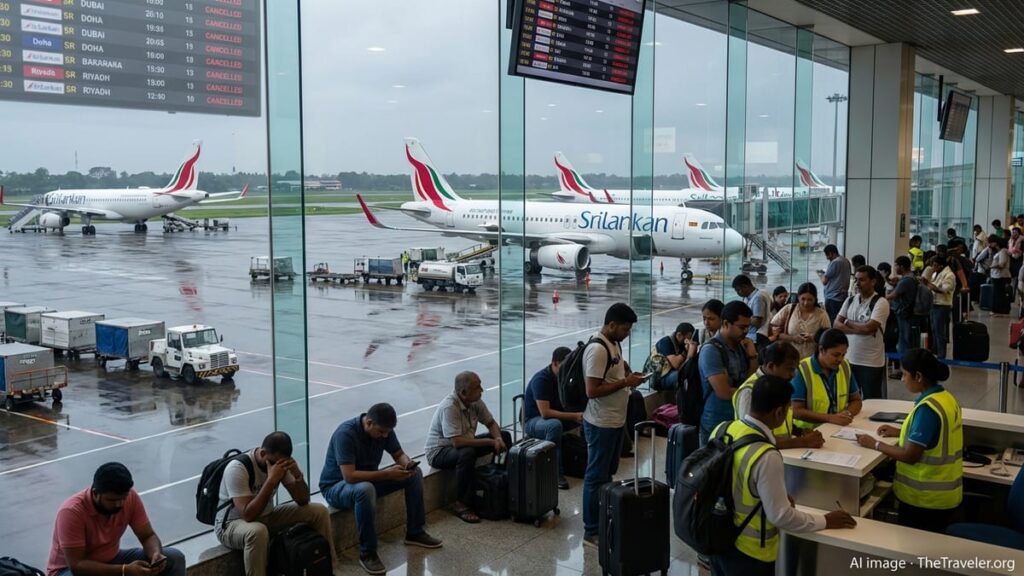
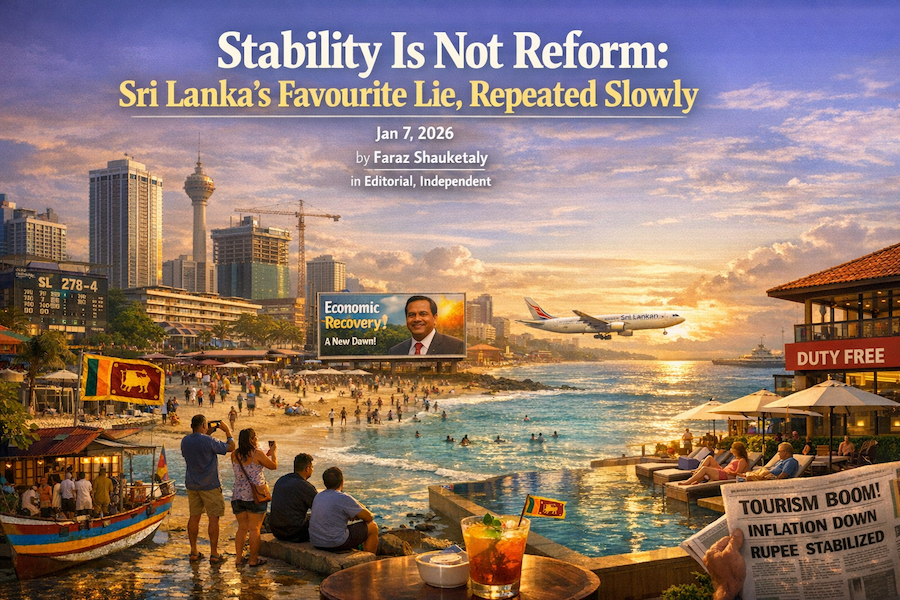
The shelves are full. Power cuts are rare. Flights are landing. Tourists are smiling. Ministers are back on panels explaining recovery. And somewhere between a cricket scorecard and a duty-free receipt, the country has decided that survival equals success.
It does not.
What Sri Lanka is experiencing is stabilisation, not reform. And confusing the two is how this country has lost entire decades without ever noticing.
The numbers, when selectively quoted, look reassuring. Tourist arrivals are climbing. Foreign exchange inflows have improved. Inflation has cooled. The currency has stopped bleeding. These are not trivial achievements in a post-crisis economy. But they are also outputs, not foundations. They describe the surface of the water, not the condition of the hull.
Scratch even lightly, and the familiar weaknesses are still there — unchanged, uncorrected, and politically inconvenient.
Start with the economy everyone is applauding.
Tourism has returned as Sri Lanka’s economic comfort blanket. Every uptick in arrivals is framed as evidence of resilience. Every hotel opening is treated as proof of confidence. This would be fine if tourism were an accelerator. But in Sri Lanka, it remains a life raft.
Tourism earns dollars. It does not build production depth. It does not diversify exports. It does not raise industrial complexity. And it does not protect the economy from the next external shock — whether geopolitical, climatic, or financial.
his is not theory. It is experience.
Sri Lanka leaned on tourism before. It collapsed anyway.
Yet the political class behaves as though tourism is a strategy rather than a stopgap. No one asks why, after repeated crises, manufacturing remains narrow, export sophistication shallow, and value addition stubbornly low. No one asks why the same handful of corporate groups still account for most serious production, exports, and tax contribution.
That silence is not accidental.
A production economy is politically uncomfortable. It demands long-term policy consistency, capital discipline, labour reform, and export survival. It cannot be announced at a press conference. It has to be endured.
Stability, on the other hand, is easy to sell.
It allows governments to declare victory without changing structure. It allows politicians to claim recovery without confronting why collapse happened in the first place. It allows institutions to revert to habit, not reform.
Nowhere is this clearer than in public health.
As dengue cases rise yet again at the start of the year, the response remains reactive, fragmented, and temporary. Emergency drives. Short campaigns. Familiar warnings. Then silence — until the next outbreak.
This is how Sri Lanka governs risk: after it materialises.
The same pattern applies to fiscal policy. Cyclone recovery spending will stretch budgets. Deficits will widen. Borrowing will rise. And once again, the country will tell itself this is unavoidable — rather than ask why resilience was never built when there was time.
The answer is uncomfortable: because resilience does not win elections. Relief does.
Globally, the hypocrisy is even starker.
The so-called democratic world now practices power without embarrassment. Governments depose, detain, supervise, and restructure other nations while continuing to lecture smaller states on sovereignty, rules, and restraint. It is empire by administrative language — clean, procedural, and utterly self- assured.
Sri Lanka watches all this from the sidelines, nodding solemnly at “rules-based order” while quietly learning the real lesson: power acts first and explainslater.
That lesson matters for small states.
Because stability without agency is fragile. And agency without production is imaginary.
Sri Lanka today is geopolitically relevant but economically shallow. It is courted strategically but weak structurally. It is stabilised financially but unreformed institutionally.
This is the danger zone — the phase where complacency sets in just as hard decisions become most urgent.
The political class is already slipping back into old language. Committees. Roadmaps. Vision documents. Conferences about competitiveness that never mention factories. Panels on growth that avoid exports. Speeches on youth that ignore skills leakage.
Meanwhile, the labour pipeline continues outward. Domestic industry struggles to scale. Tax dependence concentrates further. And the state congratulates itself for not collapsing again.
That is not progress. It is managed decline with better optics.
A real turning point would sound very different.
It would admit that stabilisation was necessary but insufficient. It would confront why production ecosystems were never replicated. It would stop romanticising consumption and start interrogating competitiveness. It would measure success not by arrivals or applause, but by how many firms can survive global markets without protection or pity.
Most importantly, it would stop lying gently to the public.
Sri Lanka does not need optimism. It needs honesty.
Because the most dangerous moment for any country is not when it is collapsing — but when it convinces itself that not collapsing is the same as moving forward.
That is the lie Sri Lanka is telling itself now.
And front pages exist for moments like this — before the next crisis arrives to correct the narrative brutally, as it always does.