The Auditor General Vacancy: Power Forgets Why the Constitution Exists
Sri Lanka does not suffer from a shortage of institutions. It suffers from a selective memory of why they were created.
The continuing failure to appoint an Auditor General —now stretching well beyond nine months—is not an administrative oversight or a procedural snag. It is a constitutional stress test. And the uncomfortable truth is that the system is holding, while the executive appears impatient with its limits.
This week’s statement by the Centre for Policy Alternatives does not indulge in drama. It does not speculate. It does not accuse.
It simply records the facts—and in doing so, exposes a deeper malaise in Sri Lanka’s relationship with accountability.
Four nominations for Auditor General have been rejected by the Constitutional Council. Four. That is not coincidence. That is a pattern.
And patterns in constitutional governance matter more than personalities.
The Office That Audits the State
The Auditor General is not a ceremonial post. It is the State’s internal conscience—constitutionally mandated to examine how public money is spent, mis-spent, or quietly disappears. In a country where financial crises have not arrived unannounced but arrived as the cumulative result of unchecked decisions, that role is foundational.
The framers of Sri Lanka’s post-17th Amendment constitutional architecture understood this. That is precisely why the power to appoint the Auditor General was not left solely with the executive. Nomination rests with the President; appointment requires the approval of the Constitutional Council.
This was not accidental. It was deliberate friction.
Friction, in constitutional design, is not inefficiency. It is protection.
What the Constitutional Council Is—and Is Not— Doing
It has become fashionable in some quarters to portray the Constitutional Council as obstructionist, elitist, or even politically motivated. This caricature collapses under minimal scrutiny.
The Council’s mandate is not to rubber-stamp executive preferences. It exists to assess suitability, independence, and integrity. Rejection is not failure of process; it is evidence that the process is functioning.
Four rejections do not indicate whim. They suggest that the nominees placed before the Council did not meet the threshold required for an office that must audit the executive, Parliament, state-owned enterprises, and every ministry that handles public funds.
If that assessment is inconvenient, the remedy is not institutional impatience. It is better nominations.
The Silence Around Public Finance
The vacancy has consequences. Serious ones.
Without an Auditor General, parliamentary oversight mechanisms such as COPE and COPA are weakened. Audit queries are delayed. Financial scrutiny becomes retrospective, if it happens at all. At a time when the State is navigating post-crisis recovery, debt restructuring, climate-related disasters, and emergency procurement, this is not a technical gap—it is an accountability vacuum.
Sri Lanka’s history offers no shortage of examples showing what happens when financial oversight is treated as optional. The results have never been benign.
The CPA’s warning is therefore understated, not alarmist.
The Political Irony
There is a deeper irony that the statement does not dwell on, but which cannot be ignored.
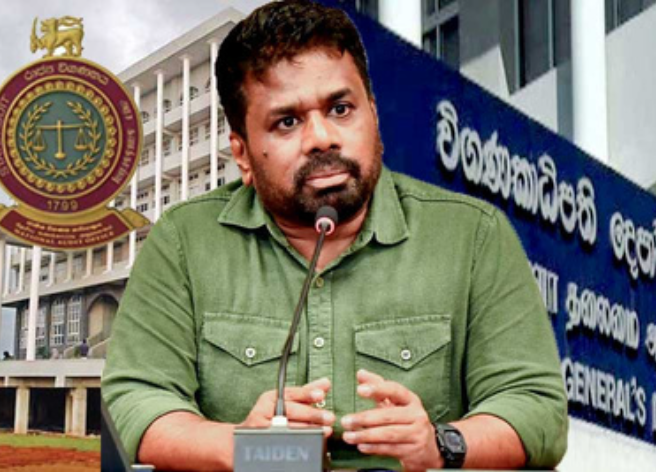
Anura Kumara Dissanayake did not arrive in office as a reluctant reformer. His political career is built on an explicit critique of executive excess and institutional capture. He was a vocal advocate of constitutional reform, including the re-establishment of independent commissions through the Seventeenth Amendment and its successors.
This is not a President discovering constraints for the first time. This is a President encountering the consequences of a system he once championed.
And that encounter appears uncomfortable.
The Constitution does not bend to political timelines or electoral mandates. It exists precisely to slow power down—to insist that authority justify itself, and that appointments to sensitive offices survive independent scrutiny.
When four nominations fail, the question that arises is not, “Why is the Council rejecting them?” but “Why are these the nominees being put forward?
This Is Not a Legal Impasse
The language of “deadlock” suggests symmetry. There is none.
The Constitutional Council has exercised its authority. The President retains the power to nominate again. There is no constitutional paralysis—only an unwillingness, or inability, to nominate a candidate who commands cross-institutional confidence.
This is not a clash between institutions. It is a test of executive judgment.
If the executive continues to treat rejection as defiance rather than feedback, the stalemate will persist. And each passing week erodes the credibility of the very reform narrative that carried this government to power.
System Change Cannot Be Selective
Sri Lanka’s political lexicon is rich in slogans and poor in patience. “System change” has become one such phrase—invoked often, examined rarely.
But system change does not mean replacing personalities while preserving habits. It means submitting to institutions even when they frustrate political preference. Especially then.
Independent commissions are not decorative features of democracy. They are obstacles placed in the path of expediency. When those obstacles are treated as inconveniences rather than safeguards, the system has not changed—only the occupant of office has.
A Simple Way Out
The solution is neither dramatic nor confrontational.
Nominate a professionally unimpeachable candidate. Engage the Council transparently.
Accept that rejection is constitutional, not personal.
The longer the vacancy continues, the more it begins to resemble indifference rather than difficulty. And indifference to audit oversight is not a neutral posture in a country with Sri Lanka’s recent financial history.
The CPA has done its duty: it has documented the problem with precision and restraint. The responsibility now rests elsewhere.
The Constitution is not asking for obedience. It is asking for respect.
And respect, in a constitutional democracy, is demonstrated not by power exercised—but by power restrained.