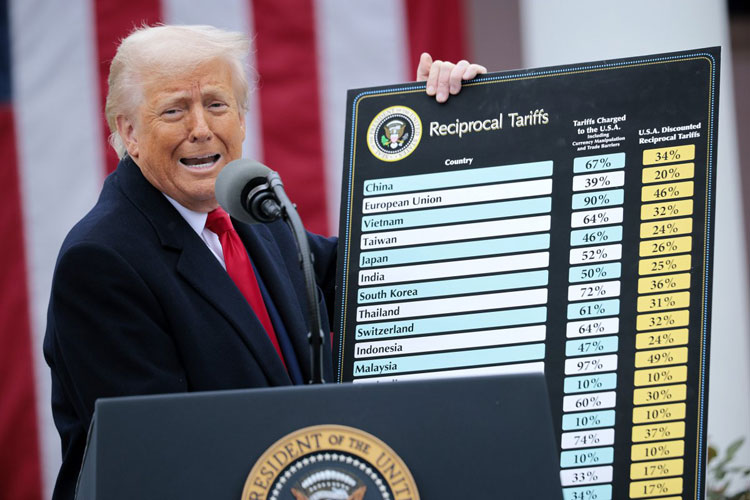
Reuters – U.S. President Donald Trump expressed intense anger following the Supreme Court’s ruling on Friday, which determined he lacked the authority to unilaterally impose tariffs on imports. In response, Trump criticized individual justices and vowed to continue his international trade war, which has caused global tension for the past year.
Despite what he repeatedly described as a “ridiculous ruling,” Trump announced an immediate new 10% tariff on imports from all countries, in addition to existing tariffs. He subsequently issued a proclamation to enact these tariffs. The law permits him to impose a levy of up to 15% for 150 days, though this action could face legal challenges.
The court’s landmark 6-3 decision disrupted the leverage Trump and his trade representatives have used in negotiations with foreign governments to reshape diplomatic relations and global markets. The ruling briefly caused U.S. stock indexes to surge before closing modestly higher, as analysts warned of renewed confusion in global markets while awaiting Trump’s next moves.
Hours after the ruling, Trump signed an executive order to repeal the tariffs that the court struck down. He also issued a proclamation enforcing a 10% duty on most goods imported into the U.S. for 150 days, with exemptions for certain items, including critical minerals, metals, and energy products, according to the White House.
TRADE DEALS, REVENUE IN QUESTION
The ruling raised questions about the trade agreements negotiated by Trump’s envoys in recent months under the threat of high tariffs. It also left uncertain the future of the $175 billion Trump has collected from U.S. importers under what the court deemed his incorrect interpretation of the law.
“I’m ashamed of certain members of the court, absolutely ashamed, for not having the courage to do what’s right for our country,” Trump told reporters at the White House, complaining that foreign countries were ecstatic and “dancing in the street.”
He insinuated, without evidence, that the court’s majority succumbed to foreign influence: “They’re very unpatriotic and disloyal to our Constitution. It’s my opinion that the court has been swayed by foreign interests and a political movement that is far smaller than people would ever think.”
Since returning to the White House 13 months ago, Trump has asserted that he had what the court summarized as the “extraordinary power to unilaterally impose tariffs of unlimited amount, duration, and scope.” Citing a national emergency, he claimed the International Emergency Economic Powers Act (IEEPA) allowed him to set tariffs at any rate he chose.
The court’s opinion, authored by Chief Justice John Roberts, referenced the U.S. Constitution: “The Congress shall have Power To lay and collect Taxes, Duties, Imposts and Excises.”
The Trump administration’s argument that it had identified a war-like emergency to justify a loophole failed to convince the court. “The Government thus concedes, as it must, that the President enjoys no inherent authority to impose tariffs during peacetime,” Roberts wrote. “And it does not defend the challenged tariffs as an exercise of the President’s warmaking powers. The United States, after all, is not at war with every nation in the world.”
Despite the court’s clear ruling that the president had exceeded his authority, Trump told reporters: “It’s ridiculous, but it’s OK, because we have other ways, numerous other ways.”
ECONOMIC UNCERTAINTY RISES
After a year of Trump’s often ad hoc tariff announcements impacting markets and the global economy, the ruling and Trump’s response reintroduced significant uncertainty that economists, investors, and policymakers had hoped was in the past.
“I think it will just bring in a new period of high uncertainty in world trade, as everybody tries to figure out what the U.S. tariff policy will be going forward,” said Varg Folkman, an analyst at the European Policy Centre think tank.
U.S. Treasury Secretary Scott Bessent stated that the court ruling could produce mixed results. “The Supreme Court has taken away the President’s leverage, but in a way, they have made the leverage that he has more draconian because they agreed he does have the right to a full embargo,” Bessent told “The Will Cain Show” on Fox News.
“We will get back to the same tariff level for the countries. It will just be in a less direct and slightly more convoluted manner,” he said.
By announcing his new temporary 10% tariff, Trump became the first president to invoke Section 122 of the Trade Act of 1974, which permits the president to levy tariffs of up to 15% for up to 150 days to address “fundamental international payments problems.” This action, too, could invite legal challenges. Such tariffs can only be extended with Congress’s authorization.