Worker remittances to Sri Lanka have reached an unprecedented high of USD 8.076 billion in 2025, marking a 22.8% increase from USD 6.6 billion in 2024. This growth is largely attributed to the significant number of worker departures in recent years.
While the contributions of migrant workers in alleviating pressure on the nation’s balance of payments are well-recognized, the challenges and sacrifices they face are often overlooked. This article sheds light on the difficulties encountered by migrant workers, drawing from two recent studies conducted by the Institute of Policy Studies of Sri Lanka (IPS).
Migrant Destinations and Remittance Origins
The primary remittance-sending countries align with the major destinations for Sri Lankan migrant workers. In 2025, the Middle Eastern region continued to be the top destination, with Kuwait leading, followed by the United Arab Emirates (UAE) and Saudi Arabia.
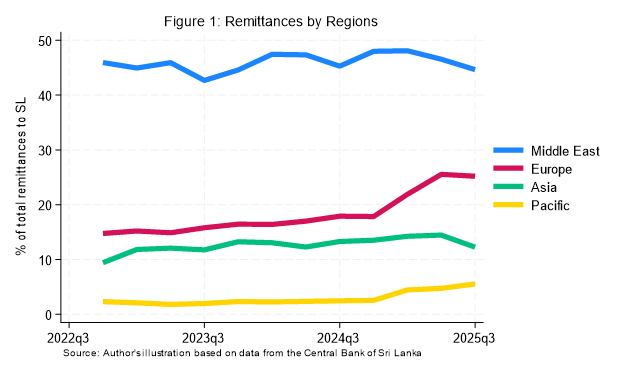
The largest share of remittances to Sri Lanka originates from the Middle East. Data from the first three quarters of 2025 show that remittances were predominantly sent from Kuwait (10.7%), UAE (10.4%), and Saudi Arabia (9.4%). However, the share from these countries has either stagnated or declined in recent quarters. In contrast, countries attracting more skilled and long-term migrants have seen an increase in their remittance contributions to Sri Lanka. For example, remittances from France, Canada, and Australia have doubled their shares between the fourth quarter of 2022 and the third quarter of 2025, while shares from Kuwait, Qatar, and Oman have decreased during the same period.
The growth in remittances could be attributed to the increase in departures of higher-skilled workers, who have a greater capacity to remit more due to their higher incomes. Other factors include an increase in formal remittances driven by a reduced gap in official and unofficial foreign exchange rates, and increased confidence in the financial system and overall economy due to the post-crisis recovery process.
Impact on Families Left Behind
Despite the higher inflows and the positive impacts of migration and remittance earnings, families left behind face significant sacrifices. An IPS study highlights the trade-offs between the economic opportunities provided by international migration and the benefits of a mother’s presence for child development.
Although around 9% of Sri Lankan households receive remittances, the study, based on data from three waves (2009/10, 2012/13, and 2016) of the Household Income and Expenditure Survey (HIES), finds that a mother’s presence at home, due to the Family Background Report (FBR) restriction, contributes to better health and educational outcomes for children. Adherence to this policy reduces outpatient visits among children under 5 years old by 14% and inpatient stays by 15.2%, compared to similar children whose mothers are not at home.
A potential counterargument is that restricting mothers’ foreign employment, and the resulting decline in overseas remittances, could reduce access to healthcare services without changing the children’s underlying health status. However, the analysis indicates that when the FBR restriction lowers remittances from abroad, it is offset by an increase in domestic remittances, leaving household income largely unchanged. Furthermore, healthcare in Sri Lanka is largely free, suggesting that the improvement in child health is likely due to the mother’s presence at home.
The study also reveals that for older children, a mother’s presence at home significantly reduces grade retention by 60% when compared to a control group. Therefore, while women’s migration for foreign employment and related remittances provide economic benefits, they also have trade-offs concerning their children’s health and education-related human capital development outcomes.
Abuse and Exploitation Abroad
Despite positive implications associated with migration, such as improved income, skills development, human capital accumulation, enhanced career mobility, and increased empowerment, migrant workers face significant sacrifices and hardships abroad. These sacrifices include family separation, debt, financial pressure, limited rights, reduced autonomy, and exposure to exploitation and abuse. The introduction of the FBR policy aimed to protect female workers from exploitation and abuse in destination countries.
An IPS study shows that 7,448 complaints were lodged in 2024 by migrant workers (2% of departures that year). Of these, 41% were reported from Saudi Arabia, 34% from Kuwait, and 10% from the UAE. A majority (76%) of complaints were made by female domestic workers from Middle Eastern countries.
The study suggests that many Sri Lankan female domestic workers migrate due to dire financial conditions, including high household debt, lack of employment opportunities, and the need to support dependents, making them economically dependent on remittances. While not all female domestic workers experience hardship or sexual and gender-based violence (SGBV), those who do are often more vulnerable to abuse. This is mainly due to delays or avoidance in reporting abuse for fear of job loss, income decline, and inability to remit earnings.
Consequently, due to an increased level of tolerance, female domestic workers often delay seeking support. For instance, some workers continued employment despite abuse and non-payment of wages, hoping to access their accumulated wages. Similarly, many were forced to change employers, despite preferring repatriation. In some cases, financial challenges associated with losing employment and difficulties in affording repatriation forced them to return to the same employer instead.
Policy Recommendations
While acknowledging the record-high remittances sent by migrant workers, it is crucial to understand the sacrifices and hardships they and their families endure and work to minimize these negative impacts. A key policy recommendation from these studies is to safeguard the rights of female workers. It is important to transition from a reactive support structure to a preemptive one. Currently, support mainly involves warning or changing employers and repatriating workers after facing and reporting SGBV. A preemptive support structure can identify risks early and provide support to prevent exposure to SGBV. For example, contacting a migrant worker within the first month of employment to assess working and living conditions can help ensure that actual conditions align with the formal employment contract, thereby minimizing future issues.
This procedure could be implemented through a telephone interview conducted by an official from the Sri Lanka Bureau of Foreign Employment, the Sri Lankan Embassy, or via a social media survey. Enhanced safeguarding of female workers’ rights would help minimize the trade-offs between the benefits of migration and remittances and the hardships and sacrifices experienced by migrant workers and their families.
Dr. Bilesha Weeraratne,
Research Fellow and Head of Migration and Urbanisation Policy Research,
Institute of Policy Studies of Sri Lanka (IPS)