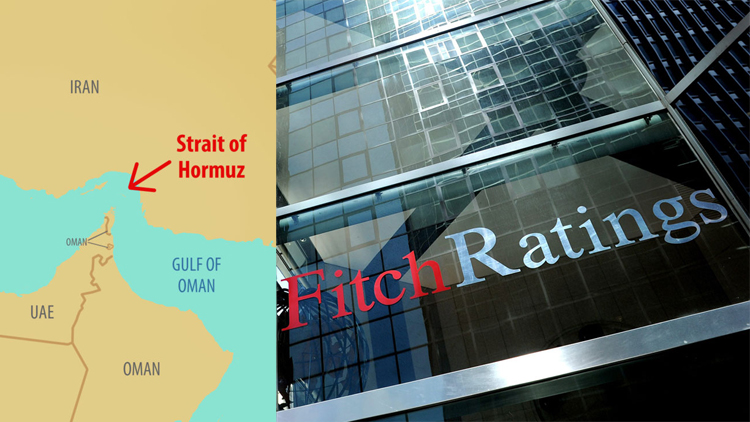
The effective closure of the Strait of Hormuz, a key driver of recent oil price increases following the outbreak of the Iran conflict on February 28, is expected to be temporary due to its crucial economic importance, according to Fitch Ratings. This, coupled with a global oversupply of oil, is anticipated to limit any significant rise in oil prices and mitigate potential disruptions to Iranian oil supply. Fitch maintains its December 2025 assumption of an average Brent oil price of USD 63 per barrel for 2026, with no significant upside expected.
While the strait is not officially closed, vessels are increasingly avoiding the area due to the risk of attacks by Iran or its proxies. Major oil companies have halted shipments for safety reasons, and insurers are withdrawing war risk coverage for vessels. However, Fitch predicts that this effective closure will be short-lived, as the strait is a vital conduit for seaborne oil transport with few alternative routes.
Before the conflict, approximately 20 million barrels per day (MMbpd) of crude oil and petroleum products passed through the strait, representing about a quarter of global seaborne oil trade and a fifth of global oil consumption. Roughly half of these volumes are exports from Saudi Arabia and the UAE, with the rest originating from Iraq, Kuwait, and Iran. About half of these exports are destined for China and India. Fitch does not expect a prolonged closure, as it would adversely impact both exporting and importing countries. Should the strait remain effectively closed for an extended period, naval protection for tankers might be considered, similar to measures during the 1980s Iran-Iraq war.
The global oil market’s oversupply is also likely to limit geopolitical risk premiums and cap potential oil price increases. In 2025, global supply growth outpaced demand growth. Fitch expects this trend to persist in 2026, forecasting supply growth of 2.4 MMbpd against demand growth of about 0.8 MMbpd. Half of the supply increase from 2025 to 2026 is anticipated to come from unaffected non-OPEC+ producers, while OPEC+ spare production capacity stands at 4.3 MMbpd.
Furthermore, global observed oil inventories grew by 1.3 MMbpd in 2025, reaching their highest level since March 2021, with total global inventories at 8.2 billion barrels at the end of 2025. This stockpile is sufficient to cover a halt in oil shipments through the Strait of Hormuz for over 400 days.
Saudi Arabia and the UAE possess infrastructure that can bypass the strait, potentially mitigating transit disruptions. Saudi Aramco operates the 5 MMbpd East-West crude oil pipeline to an export port on the Red Sea, while the UAE has a 1.5 MMbpd capacity pipeline connecting its oil fields to the Fujairah export terminal on the Gulf of Oman, achieving a maximum flow of 1.8 MMbpd.
Although Iran is a significant oil producer, generating about 3.5 MMbpd and exporting approximately 2 MMbpd, it accounts for only about 3.5% of global crude oil production. Therefore, any potential supply disruption could be offset by the global market’s oversupply.
Nonetheless, the duration and intensity of the regional conflict remain uncertain. Any prolonged blockage of the strait or significant damage to the region’s oil and gas production and transportation infrastructure could materially impact oil markets and lead to a more substantial increase in Fitch’s base case 2026 oil price assumption. Oil price volatility would likely escalate if there were any significant disruption to Iranian oil production.