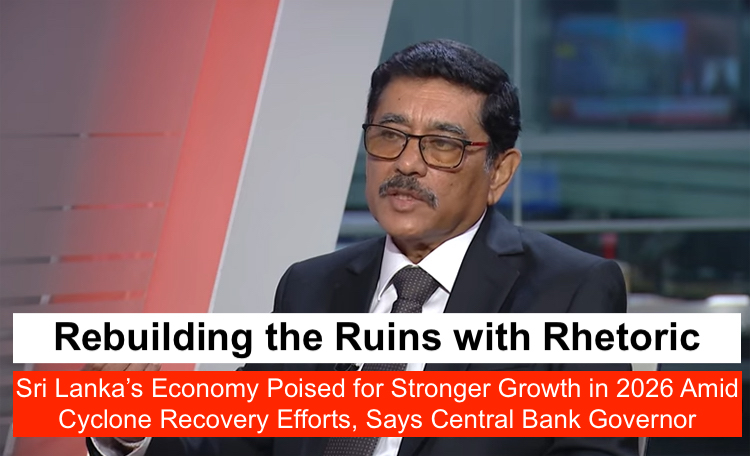
Sri Lanka has just endured one of the worst natural disasters in its post-independence history. Cyclone Ditwa has inflicted devastation across livelihoods, infrastructure, agriculture, and public finances, with reconstruction costs now estimated at USD 4.1 billion. Yet, at this moment of national trauma, the Governor of the Central Bank, Nandalal Weerasinghe, has chosen to frame catastrophe as an opportunity for “stronger growth” and fiscal stimulus. This is not economic realism; it is narrative management.
To argue that cyclone-induced reconstruction spending will lift growth beyond 5% is to reduce economic well-being to a GDP accounting exercise, divorced from human suffering and structural damage. Yes, reconstruction adds to measured output—but only because destruction first erased capital stock, homes, roads, and productive capacity. Calling this “growth” is akin to celebrating higher hospital bills after a national health emergency.
More troubling is the assertion—widely echoed in official commentary—that the cyclone has no material impact on debt sustainability because the Government is not taking on new debt. As economist rightly warned, this reasoning dangerously narrows the definition of sustainability. It ignores productivity losses, fiscal stress, disrupted livelihoods, weakened household balance sheets, and erosion of public assets. Debt sustainability is not merely a spreadsheet outcome of borrowing flows; it is inseparable from the real economy’s ability to generate future income and revenue.
This line of thinking exposes a fragile and increasingly tenuous relationship between Sri Lanka’s Debt Sustainability Analysis (DSA) frameworks and lived economic reality. A country can technically “avoid new debt” while still sliding into deeper vulnerability through lost output, emergency expenditure reallocations, import surges, and social dislocation. Treating disasters as DSA-neutral events is not prudence—it is institutional blindness.
The Governor’s appearance did acknowledge risks—higher inflation, import pressure, foreign exchange strain—but these caveats function more as disclaimers than genuine recalibrations. The central message remains upbeat: growth will recover, spending will stimulate, and the system will hold. This is less independent central banking and more state-aligned reassurance, designed to project control rather than confront fragility.
A central bank’s credibility does not come from optimism; it comes from intellectual honesty. In moments of national crisis, its role is not to act as a cheerleader for fiscal expansion or a shield for political narratives, but as a sober interpreter of risks, trade-offs, and long-term costs. When disaster reconstruction is framed primarily as a growth accelerator—rather than a setback requiring painful reprioritisation—the institution risks becoming a messenger of convenience rather than an anchor of stability.
Sri Lanka does not need cosmetic confidence. It needs a clear-eyed admission that Cyclone Ditwa has weakened an already fragile recovery, strained public finances, and exposed how thin the margin is between macro “stability” and real economic resilience. Anything less is not optimism—it is denial dressed up as policy.