Former Military Intelligence Chief, Suresh Sallay Arrested under PTA
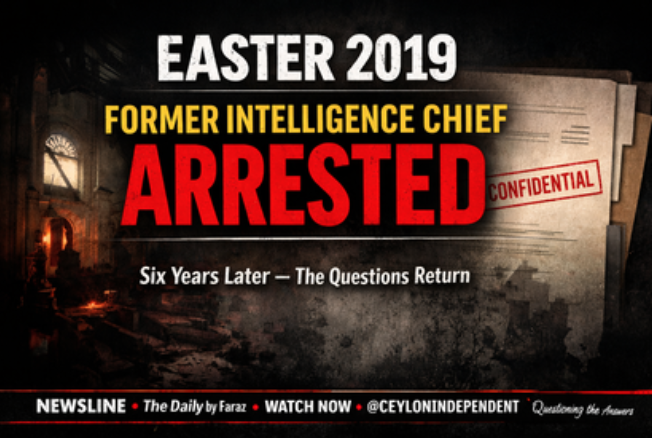
Nearly six years after the Easter Sunday bombings of 2019, a significant development has shaken the investigative landscape. Retired Major General Suresh Sallay, former Head of Military Intelligence, has been arrested for questioning in connection with the attacks. This is not a routine procedural footnote. It is a moment that touches the very core of the unanswered questions that have haunted Sri Lanka since April 21.
From the earliest hours after the bombings, one question refused to fade: did elements within the State’s intelligence apparatus possess prior knowledge of the plot? Foreign intelligence warnings were documented. Alerts were reportedly circulated internally. Names were known. Yet the churches and hotels were struck with devastating precision.
In 2022, that same question was reignited internationally through a Channel 4 commissioned documentary produced by Ben de Pear and Basement Films. The film examined allegations that intelligence-linked actors may have had foreknowledge.
Former President Gotabaya Rajapaksa declined an invitation to participate in the documentary and later described it as “absurd” and “a tissue of lies.”
Major General Sallay formally complained to OFCOM; the UK regulator ruled that the broadcaster had given him adequate opportunity to respond and found no grounds to censure the programme. Pillayan, who was referenced in the documentary, cast doubt on the credibility of Azad Maulana — once his private secretary and a principal voice in the film — suggesting Maulana’s statements were motivated by efforts to secure asylum in Europe.
The controversy never fully subsided. It lingered in public discourse, especially within the Catholic community, where grief has remained intertwined with frustration over the absence of closure.
In Parliament, Field Marshal Sarath Fonseka made a remark that continues to echo: “For the Head of Intelligence to obtain a passport is a matter accomplished over the telephone.” The comment was not an accusation, but it underscored the extraordinary reach and influence associated with senior intelligence office.
It is also worth recalling that the former head of the State Intelligence Service (SIS) was discharged as a police officer following findings by a Parliamentary Commission and the Police Commission, both of which recorded fault. That episode demonstrated that institutional accountability, however delayed, was not entirely beyond reach.
The arrest of a former Military Intelligence chief does not establish guilt. It does, however, signal that investigators may now be prepared to step into previously insulated territory. For years, critics argued that accountability stalled at the outer edges of power. If this development represents substantive investigative progress rather than symbolic theatre, it marks a turningpoint.
The new President and his administration, for now, appear to be moving decisively, distancing themselves from past inertia. But arrests are not answers. Questioning is not conviction. And suspicion is not proof.
For the families of the victims — and for a nation that still carries the memory of that Easter morning — what matters now is whether this process finally leads to clarity.
Six years is an eternity in grief.
If this is the beginning of truth, history will remember it. If not, it will be another chapter in a story of deferred justice.
Sri Lanka waits.