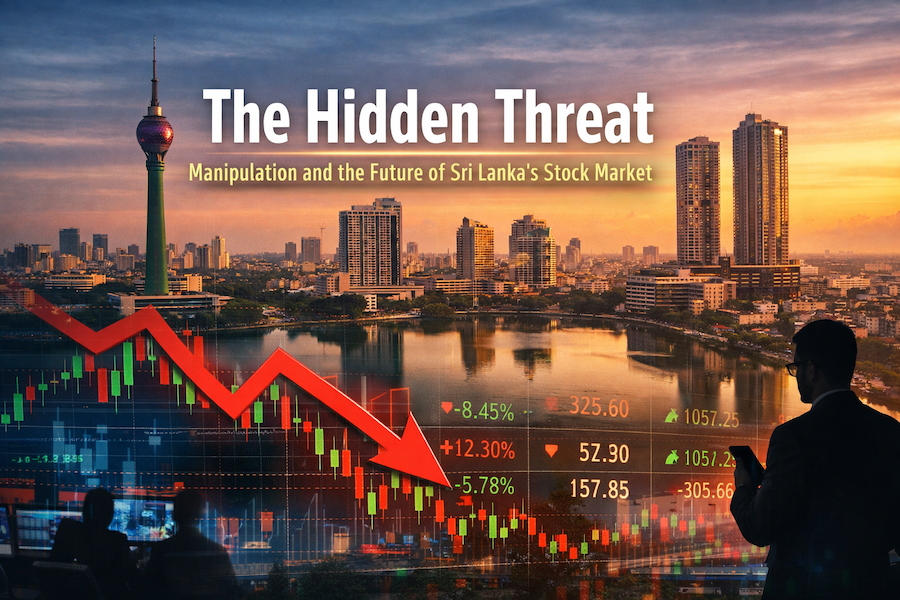
The recent actions taken by the Securities and Exchange Commission of Sri Lanka (SEC) in relation to Blue Ocean Securities mark an important and commendable step in safeguarding the integrity of the Colombo Stock Exchange (CSE). At a time when market confidence is fragile and retail participation is rising rapidly, decisive regulatory intervention sends a clear signal that misconduct will not be tolerated.

The SEC deserves credit for acting to protect investors and uphold market discipline. However, while such enforcement actions are necessary, they are not sufficient. The uncomfortable truth is that the most serious threat to Sri Lanka’s capital market today is not external it is internal. The enemy is within the market itself.
Market manipulation in its various forms has become increasingly normalised, involving almost every category of participant.
Stockbroking companies, under pressure to grow revenues, often prioritise trading volumes and speculative activity over sound investment advice. Excessive churning, aggressive promotion of certain counters, and short-term price chasing are sometimes driven more by brokerage income than by fundamentals.
Investment advisors, too, play a critical role in distorting market behaviour. In the race to appear “right” and deliver quick gains, some advisors actively push prices upward by encouraging herd behaviour, selectively highlighting positive narratives while ignoring underlying risks. This creates artificial momentum, drawing unsuspecting investors into stocks that may not justify their valuations.
Listed companies are not passive observers in this process. Some actively attempt to push up their own share prices through various methods—optimistic forward-looking statements unsupported by earnings, selective disclosure of information, revaluation-driven balance sheet optics, or maintaining low public floats that make prices easier to influence. These actions may not always cross clear legal boundaries, but collectively they undermine price discovery.
Company directors add another layer of concern. Director dealings, while legal when properly disclosed, can be strategically timed to signal false confidence to the market. In certain cases, clusters of director transactions during price run-ups raise legitimate questions about intent and information asymmetry.
Investors and Traders At the retail level, individual investors and traders increasingly use social media platforms, messaging apps, and online forums to promote stocks. Positive “recommendations” are circulated widely, often with little regard for the true financial position of the company or prevailing market risks. Rumours, selective facts, and exaggerated claims spread rapidly, amplifying volatility and distorting investor decision-making.

Under these circumstances, a market correction or even a sharp crash is not a question of “if” but “when.” History has repeatedly shown that markets driven by manipulation, excessive optimism, and weak enforcement eventually correct, often brutally, leaving retail investors bearing the heaviest losses. When that happens, confidence in the entire capital market suffers, undoing years of progress in market development and financial inclusion.
This is where the role of the regulator must evolve. The SEC’s responsibility cannot be limited to reactive enforcement against isolated entities after damage has been done. To truly safeguard the market from the enemy within, the regulator must adopt a more holistic, proactive approach. This includes enhanced real-time surveillance to detect unusual trading patterns across brokers, funds, directors, and retail clusters; stricter scrutiny of price-sensitive disclosures and director dealings; and meaningful penalties that remove the financial incentive to manipulate rather than treating fines as a cost of doing business.
Equally important is accountability across the entire value chain. Stockbroking firms must be held to higher standards of conduct, investment managers must be challenged on market-wide impact rather than just fund-level returns, and listed companies must be reminded that the market exists to allocate capital efficiently—not to serve as a price-support mechanism for insiders. Social media manipulation, too, cannot be ignored simply because it is decentralised; regulatory frameworks must adapt to modern channels of influence.
The Blue Ocean Securities case should therefore be seen not just as an isolated enforcement success, but as a warning sign. Applauding the SEC is justified—but expecting more from it is essential. If Sri Lanka’s stock market is to mature into a credible, resilient platform for capital formation, the regulator must confront the uncomfortable reality that manipulation today is systemic, not exceptional. Only by addressing the enemy within can lasting market stability and investor trust be achieved.