The United Nations was born from ashes. Quite literally.
In 1945, after humanity demonstrated an industrial-scale talent for killing itself, the world attempted something radical: a forum where power would argue before it bombed, where law would at least pretend to matter, and where the phrase “never again” would mean more than a commemorative plaque.
Eighty years on, the question is no longer whether the UN is imperfect. It always was. The question is far more existential:
Does the UN still function as an instrument of restraint — or has it become a spectator with a microphone?
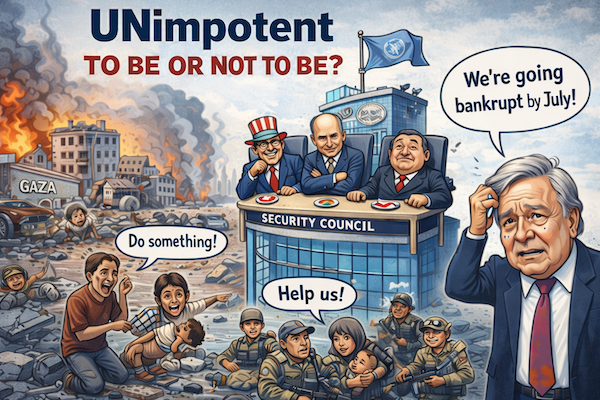
That this question arises just as the UN Secretary-General warns of potential bankruptcy by July this year is not coincidence. Institutions rot financially only after they rot politically.
THE THINGS THE UN DID RIGHT — AND WE FORGET TOO EASILY
It is fashionable to sneer at the UN. That fashion ignores history.
The UN helped dismantle formal colonialism, giving political birth certificates to dozens of nations that would otherwise still be wards of empire. It built a global architecture of norms — human rights, refugee protection, humanitarian law — that did not exist before 1945.
UN peacekeeping missions, while imperfect, have prevented conflicts from metastasising into regional wars in places that never make the front page because disaster was averted. That is the paradox of prevention: success looks like nothing happened.
UN agencies have vaccinated millions, fed the starving, coordinated disaster relief after tsunamis, earthquakes, floods, and wars. They eradicated smallpox. They expanded education for girls. They created frameworks for climate cooperation long before climate became fashionable politics.
If the UN did not exist, the world would have had to invent it.
The tragedy is that the world has since stopped believing in it.
FROM ARBITER TO BYSTANDER
The UN’s failures are no longer episodic. They are structural.
Gaza is not a diplomatic failure; it is a moral implosion broadcast in real time. Resolutions pile up like gravestones while civilians pile up beneath rubble. Veto power renders the Security Council a hostage chamber, where permanent members decide whose lives are negotiable.
Palestine has become the UN’s longest-running exercise in rhetorical endurance — decades of resolutions, declarations, special envoys, and precisely zero enforcement.
Myanmar exposed the UN’s allergy to naming perpetrators until it is too late. Sri Lanka’s civil war ended not with accountability but with international amnesia, leaving “reconciliation” as a word without consequences.
The Rohingya were ethnically cleansed in slow motion while the UN filed reports with exquisite footnotes. Iraq demonstrated how easily international law collapses when power decides to act first and justify later.
India’s internal conflicts and regional dominance are treated with diplomatic delicacy rather than principled clarity — because size, markets, and alliances matter more than consistency.
This is not neutrality. It is paralysis dressed as balance.
THE TYRANNY OF THE VETO
The UN’s core contradiction sits at the heart of the Security Council.
Five permanent members, armed with vetoes designed for a bipolar world that no longer exists, can override the will of the global majority. The result is not stability but selective morality.
International law becomes enforceable only against the weak. Accountability applies downward, never upward. Justice is conditional on geopolitics.
This is why the UN can investigate endlessly but enforce rarely.
It is why victims know the language of resolutions but not the experience of justice.
BANKRUPTCY IS NOT JUST FINANCIAL
The Secretary-General’s warning of impending bankruptcy by July should alarm even the cynics. But let us be clear: the UN did not run out of money because the world ran out of cash
It ran out of credibility.
Member states delay contributions not because they cannot pay, but because they no longer believe the institution delivers outcomes proportional to its rhetoric. When power bypasses the UN with coalitions, unilateral actions, and “rules-based orders” that come with footnotes, funding becomes optional.
You do not starve institutions you respect.
You starve the ones you plan to ignore.
TO BE — OR NOT TO BE?
So, is the UN finished? No. But it is dangerously close to becoming irrelevant.
The choice before the UN is Shakespearean, not bureaucratic.
To be relevant, it must confront power, not accommodate it. It must reform the Security Council or accept that legitimacy cannot survive permanent inequality. It must abandon the comfort of process when outcomes are obscene.
And member states — especially the Global South — must stop treating the UN as a theatre for speeches and start demanding it function as an instrument of consequence.
The UN was never meant to be perfect. It was meant to be useful.
If it cannot protect civilians, enforce international law consistently, or even pay its own staff, then history will not remember it kindly. It will remember it as an institution that spoke fluently while the world burned.
The UN can still matter. But only if it chooses courage over caution, reform over ritual, and justice over diplomacy-for-its-own-sake.
Otherwise, the question answers itself. To be — or not to be.