By Kithmi Gunaratne
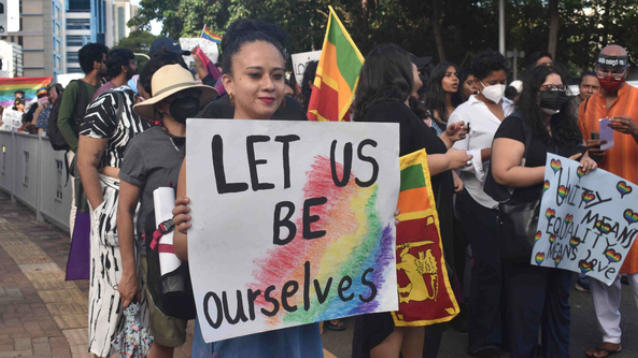
In Sri Lanka, you can be harassed, arrested, or forced into silence not for what you have done, but for who you are. Same-sex relationships remain criminalised under Sections 365 and 365A of the Penal Code, colonial-era laws that continue to shape modern lives. According to Human Rights Watch (2016), LGBTQ+ Sri Lankans have reported police harassment, arbitrary arrests, and degrading treatment, while Equal Ground documents widespread discrimination and social exclusion. The law may sit quietly on paper, but its consequences are anything but.
There is a tension that runs through Sri Lankan society, not always spoken, but deeply felt. It lives in glances, in silences, in the careful editing of one’s identity before stepping into public space. For many LGBTQ+ Sri Lankans, life unfolds between fear and hope: fear of rejection or exposure; hope for dignity and the simple right to exist without apology.
I write this as someone who has never had to live this reality. I have never had to fracture myself to fit into a room, to measure my words against the risk of exposure, or to rehearse a version of myself that feels safer than the truth. That, in itself, is a privilege easily overlooked. But in speaking with members of the LGBTQ+ community, what becomes clear is not simply difference, but the quiet, relentless labour of concealment: the careful editing of identity, the calculated silences, the exhausting awareness that authenticity can come at a cost.
And yet, this reality is often defended in the name of culture.
But the contradiction is difficult to ignore. The legal foundation for criminalisation in Sri Lanka does not originate in its traditions, but in British colonial law. One of its earliest expressions was the Buggery Act of 1533, enacted under Henry VIII, which transformed sexuality from a moral question into a criminal offence. Through colonial expansion, these laws were imposed across vast parts of the world, including Sri Lanka. What is often defended today as cultural preservation is, in reality, the preservation of a colonial legacy.
History matters because it reveals what has changed and what has not. These laws were once justified by appeals to morality, social order, and rigid ideas of family. But modern societies are not built on enforcing a single moral code, nor does diversity threaten stability. Scientific and psychological understanding has also evolved, seeing sexuality not as a deviation to be corrected, but as an ordinary and unremarkable part of being human. What remains instead is a law that punishes without protecting and restricts without justification.
More importantly, its consequences are not abstract. They are lived. When the law marks a group of people as criminals, it quietly authorises discrimination to follow. It shapes how institutions respond, how communities behave, and how individuals come to see themselves. Even when unenforced, it leaves behind a constant message: that some identities must remain hidden to be tolerated.
This is not simply legal exclusion. It is emotional and psychological containment, the slow erosion of selfhood that comes from living a life negotiated in fragments.
None of this requires a rejection of Sri Lanka’s traditions or cultural identity. On the contrary, it calls for a deeper engagement with them. Culture is not static; it evolves through reflection, dialogue, and a willingness to confront its own contradictions. To recognise the dignity of LGBTQ+ individuals is not to undermine tradition, but to ask whether tradition, at its best, can expand rather than exclude. If compassion and community are truly central to Sri Lankan culture, then inclusion is not a departure from tradition, but a continuation of it.
Sri Lanka already possesses the moral language for this shift.
Buddhism, which shapes much of the country’s ethical imagination, is grounded in karuṇā and mettā, compassion and loving-kindness. It asks not who one loves, but whether one causes harm. Christianity, too, centres dignity, mercy, and care for those pushed to the margins. Pope Francis’s question, “Who am I to judge?”, does not resolve every doctrinal debate, but it shifts the moral lens away from condemnation and toward humanity. Read through their ethical core, both traditions point not toward exclusion, but toward compassion.
Even if full social acceptance remains distant, decriminalisation is the minimum. It does not require moral agreement. It requires restraint: that the state no longer punishes people simply for who they are.
Because this is not about culture. It is about dignity.
And dignity cannot wait.
Not for politics.
Not for comfort.
Not for permission.
A country that teaches compassion cannot choose who deserves it. Whether through the quiet wisdom of Buddhism or the enduring call to love within Christianity, the message is the same: dignity is not conditional. And a society that asks some of its people to live in silence must confront a harder truth:
What kind of humanity is it protecting?
(Kithmi Gunaratne is a published poet and a student of International Relations)