By Kithmi Gunaratne
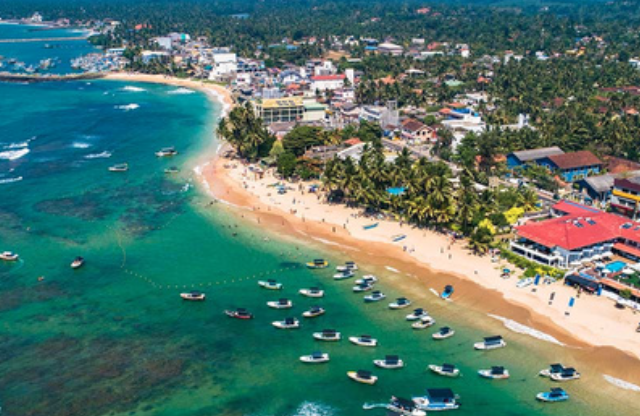
For decades, Hikkaduwa stood as Sri Lanka’s most recognisable beach destination. Backpackers in the 1970s and 80s built its reputation as a laid-back surf town; divers came for its coral reefs; travellers lingered for its easy rhythm of fishing boats at dawn and beach bars at dusk. It was vibrant but unpolished, lively, imperfect and unmistakably grounded in local life.
Today, that balance feels strained.
Hikkaduwa’s early fame created a tourism blueprint focused heavily on volume. Hotels multiplied along the Galle Road strip, restaurants leaned into quick-turnover menus, and beachfront plots became increasingly commercialised. What began as organic growth gradually hardened into a strip of concrete, signage and competition for footfall.
With expansion came a steady rise in prices. Accommodation rates climbed. Seafood dishes once sourced directly from local fishers became premium- priced tourist items. Even basic services began reflecting a kind of destination inflation. Visitors frequently remark that prices in Hikkaduwa rival and sometimes exceed those in newer southern hotspots, without a corresponding leap in infrastructure or quality.
The paradox is hard to ignore: a town once celebrated for accessibility now feels financially exclusionary to the backpacker culture that built its international reputation. Long-stay travellers who once lingered for weeks now pass through quickly, if at all.
Environmental strain has compounded the problem. At the heart of Hikkaduwa’s appeal was its coral reef, now protected within Hikkaduwa National Park. Yet decades of intense snorkelling tours, glass-bottom boats, coastal construction and pollution have degraded sections of coral. Marine ecosystems can recover, but only with time and rigorous protection. Years of inconsistent regulation have left visible scars.
As reefs decline, so too does the experience that once differentiated Hikkaduwa from other beaches along Sri Lanka’s southern coast. Environmental damage is not simply an ecological issue; it is an economic one. A destination built on natural beauty cannot afford to neglect its foundations.
Meanwhile, the fishing community that predates tourism by generations navigates a shifting landscape. At dawn, boats still return with their catch and markets still stir to life. But the economics have changed. Restaurants and hotels often secure seafood through tourism-focused supply chains that prioritise bulk purchasing and contract reliability over the rhythms of the open market. What was once a communal, local trade increasingly feels curated for visitor consumption.
Fisherfolk face rising fuel costs, fluctuating fish stocks and mounting coastal pressures. Yet the most visible profits of tourism frequently accrue to hospitality operators and outside investors rather than to the fishing families whose labour sustains the seafood economy. The fish market survives, but it competes with the optics of boutique dining and Instagram-ready platters priced far beyond local norms.
Just down the coast, other towns have begun to capture the narrative that once belonged to Hikkaduwa. Ahangama, Hiriketiya, Mirissa which are quiet surf villages, now attract digital nomads, boutique hotel developers and a younger, lifestyle-driven clientele. Its appeal lies partly in perception: less chaotic, less densely commercialised, more curated. Cafés double as co- working spaces. Architecture leans minimalist. The mood is marketed as intentional and slow.
In many ways, these towns now stand where Hikkaduwa once did, emerging, authentic and slightly ahead of the mass-tourism curve. The shift is not accidental. Travellers increasingly seek environmental awareness, cultural depth and a sense of discovery over crowded familiarity. The southern coast’s centre of gravity is edging further along the shoreline.
Yet this is not simply a story of decline. Hikkaduwa retains formidable strengths: strong rail connectivity from Colombo, international name recognition, established infrastructure and a resilient local community accustomed to adapting. Its challenge is not survival, but reinvention.
Reinvention, however, requires more than cosmetic change. It would mean stricter environmental enforcement and meaningful investment in reef restoration. It would demand clearer pricing standards and improved service quality to rebuild trust. It would involve ensuring that fishing families and small-scale entrepreneurs share equitably in tourism revenue, rather than existing at its margins. And it would require urban planning that curbs further unregulated beachfront development in favour of aesthetic and ecological coherence.
Coastal tourism has a predictable arc. Charm attracts visitors; visitors attract investment; investment, if unchecked, erodes the very charm that drew attention in the first place. Hikkaduwa has travelled far along that curve. Whether it continues toward stagnation or pivots toward sustainability will depend on choices made now. The rise of Ahangama, Mirrissa and Hiriketiya should not be read as Hikkaduwa’s obituary.
It is, instead, a mirror reflecting changing traveller expectations and the consequences of unchecked growth. If Hikkaduwa can confront that reflection, honestly balancing marine conservation, fair economics and thoughtful planning ,it may yet reclaim not just its identity, but its integrity.
Coastal towns, like coral reefs, are living systems. They bleach under pressure, but with care and patience they can regenerate. The question facing Hikkaduwa is whether it will repeat the cycle of overexpansion or become an example of how a destination, once stretched thin by its own success, can chart a more sustainable future along Sri Lanka’s southern shore. (The author is a poet – ‘Through the Eyes of Life’ and is a student of International Affairs)