Walk the southern coast at sunset and you will see the postcard version of Sri Lanka. Surfboards. Boutique villas. Avocado toast. Card-only cafés. Ask a few local hoteliers what they think and the postcard fades.
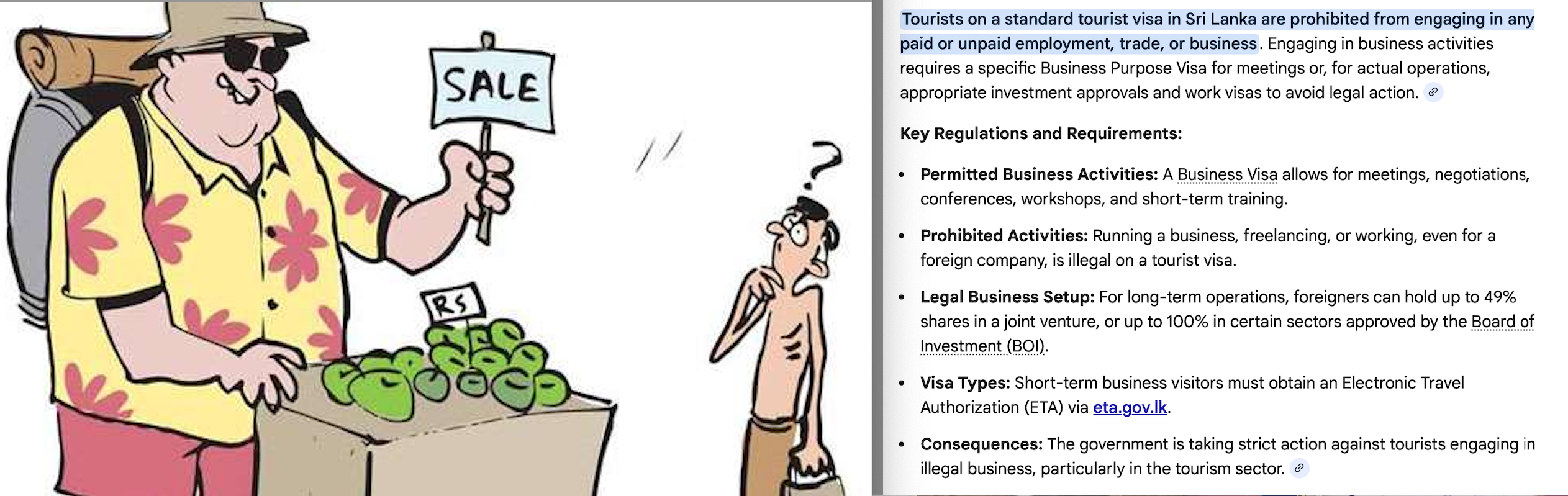
There is a claim spreading fast across coastal districts: that foreigners arrive on tourist visas, fast-track paperwork through local intermediaries, operate guesthouses under nominee structures, collect card payments routed offshore, and remit profits out of Sri Lanka without meaningful tax or foreign-exchange capture.
It is a powerful allegation. Is it true?
The Visa Question
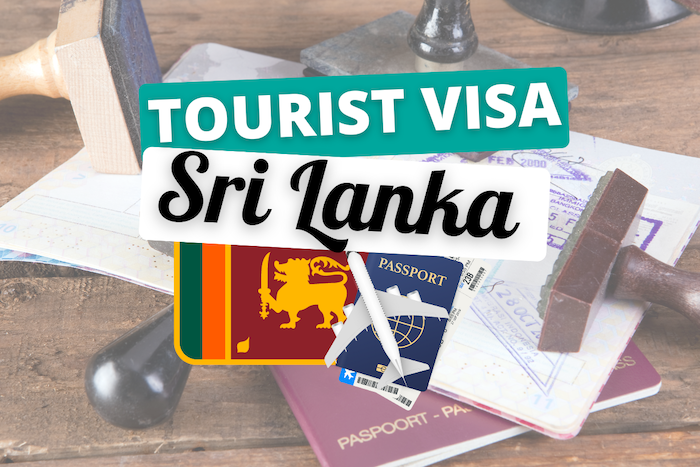
Under Sri Lankan law, a tourist visa does not permit employment or business operation. Foreign nationals wishing to operate enterprises must obtain appropriate investor visas, BOI approvals, or company registrations.
Yet immigration enforcement in Sri Lanka has historically been uneven.
Are some individuals operating businesses while technically on tourist status? Have overstays been systematically audited?
How many prosecutions have followed?
If the Government knows, it has not published the numbers. Silence breeds suspicion.
The Nominee Structure Puzzle
Here is where the issue becomes murkier.
A Sri Lankan citizen can legally register a company. A foreign partner can legally invest capital. Profits can legally be repatriated as dividends if taxes are paid. None of that is unlawful.
But if:
The foreign individual is effectively managing operations without proper visa status, The business structure masks operational control,
Income is partially undeclared,
Merchant accounts are domiciled abroad,
then we move from entrepreneurship into regulatory evasion.
The line between legal structuring and abuse is thin — and enforcement determines where it sits.
The Card-Only Anxiety
This is where public anger sharpens.
Many boutique properties prefer card payments. That is not unusual in tourism. However, if payment gateways are registered overseas and settlements land in foreign bank accounts before any domestic reconciliation, Sri Lanka loses immediate foreign exchange inflow visibility.
Is that illegal? Not automatically.
Booking platforms such as Airbnb and international payment processors commonly settle offshore before remitting net proceeds. This is global practice.
But in a dollar-scarce economy, optics matter.
If locals see full houses, foreign guests, card machines buzzing — yet foreign exchange reserves barely improving — the question becomes inevitable:
Who is capturing the value?
The Enforcement Vacuum
There is currently no publicly released audit showing widespread illegal foreign control of Sri Lanka’s coastal tourism.
But there are:
Periodic immigration raids.
Local complaints of unfair competition. Claims of informal partnerships. Political rhetoric amplifying resentment.
In the absence of transparent data, anecdote becomes accepted truth. That is dangerous.
The Political Undertone
Sri Lanka is economically fragile.
When domestic entrepreneurs struggle with taxes, licensing delays, and compliance burdens — the perception that “outsiders” operate with fewer constraints fuels anger.
Whether that perception is fully accurate or not becomes secondary.
Economic pain magnifies narratives.
The Real Question
This is not about xenophobia. Foreign investment is essential to tourism growth.
The real issue is enforcement parity. Are visa rules applied equally?
Are tax filings audited rigorously? Are merchant settlements monitored? Are BOI approvals transparent?
If yes, publish the data. If no, fix it.
NEWSLINE Verdict
Right now, the claim that foreigners are quietly dominating coastal hospitality under tourist visas is widespread. Proof is limited. Transparency is absent.
In a post-crisis economy, opacity is combustible.
If the Government wants to extinguish this narrative, it must do one thing: Open the books.
Because in the absence of evidence, suspicion will continue to do what markets do best – Grow.