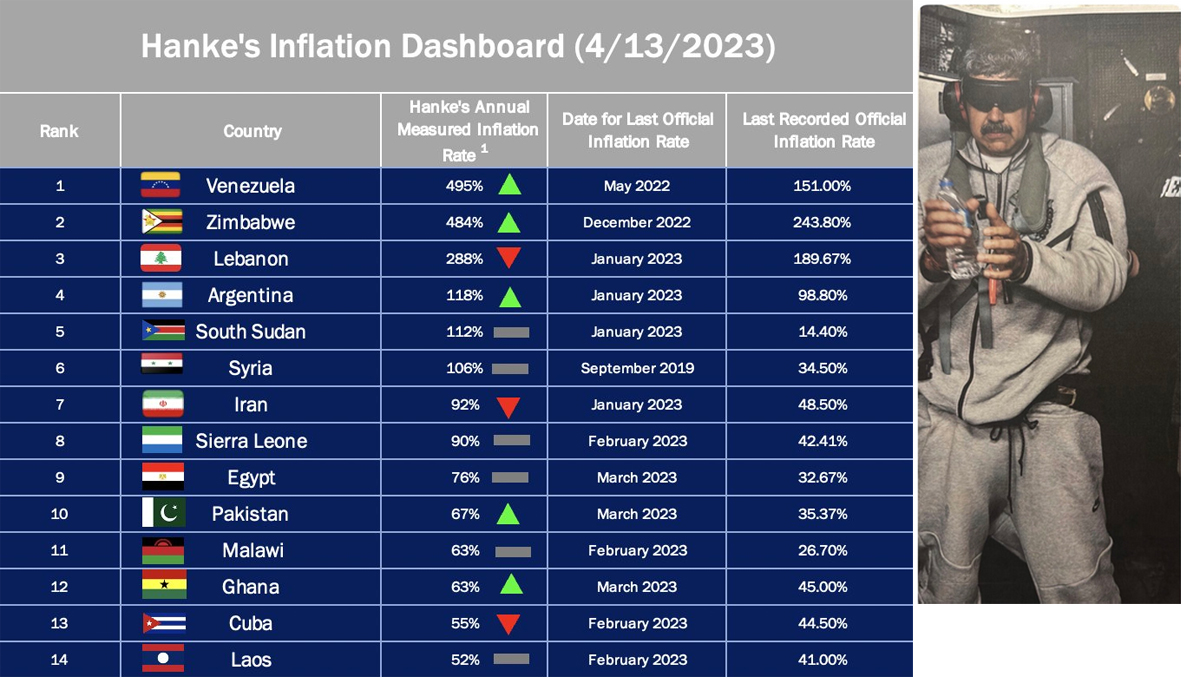
The United States faces a potential crisis if it proceeds with plans to manage Venezuela, a nation suffering from severe instability and unspecified inflation rates, according to a prominent U.S. economist. This warning comes in the wake of a high-stakes operation led by President Trump that resulted in the capture of Venezuelan President Nicolás Maduro and First Lady Cilia Flores.
President Trump, speaking to reporters, stated, “We are going to run the country.” This statement has sparked concerns among experts, including a Professor of Applied Economics at Johns Hopkins University, who tweeted, “Uncle Sam’s going to have a big mess on his hands.” The economist pointed out that Venezuela has not released official inflation data since October 2024, highlighting the challenges the U.S. might face.
Venezuela is grappling with serious monetary instability and a significant outmigration problem. Governing nations with ineffective central banks is notoriously challenging, as economic liberalization efforts are often discredited, leading to the swift removal of liberal governments. Typically, only authoritarian regimes that frequently manipulate elections can maintain control in such environments. Interestingly, President Trump himself was elected during a period of inflation and instability in the United States.
According to estimates by economist Steve Hanke, Venezuela’s annual inflation rate was around 549 percent as of November, trailing North Korea’s 201 percent and Iran’s 60 percent. The official exchange rate announced by Venezuela’s central bank was 304 bolivars to the U.S. dollar in the first week of 2026, a massive increase from 52 to the dollar in early 2025. Meanwhile, the black market exchange rate for the bolivar was reported to be around 560 to the U.S. dollar.
President Trump acknowledged that Venezuela’s extensive oil reserves influenced the decision to intervene. “We’re going to be running it with a group and make sure it’s run properly,” he stated, expressing plans to rebuild the oil infrastructure, a project expected to cost billions of dollars, to be funded by oil companies. “They will be reimbursed for what they’re doing, but that’s going to be paid. And we’re going to get the oil flowing the way it should be,” he added.
Trump also mentioned discussions with Venezuela’s Vice President but did not provide further details. He claimed, “You know, they stole our oil. We built that whole industry there and they just took it over like we were nothing.” He criticized previous U.S. administrations for their inaction, asserting, “We did something about it. We’re late, but we did something about it.”
Trump’s reference to “stolen” oil likely pertains to the expropriation of U.S. and other Western oil companies, which were initially involved in discovering and extracting Venezuela’s oil. The nationalization of the oil industry, particularly under Hugo Chávez, severely weakened the state oil firm PDVSA, which now struggles to invest in necessary infrastructure amid ongoing monetary instability. Venezuela’s oil production has plummeted from 3 million barrels per day to a third or less, with China being a major purchaser of its oil.
The United States has imposed sanctions on Venezuela, which Hanke has previously criticized. He argues that such sanctions can create a “rally around the flag” effect, bolstering authoritarian leaders and exacerbating economic hardships for citizens in inflation-ridden countries with autocratic regimes.