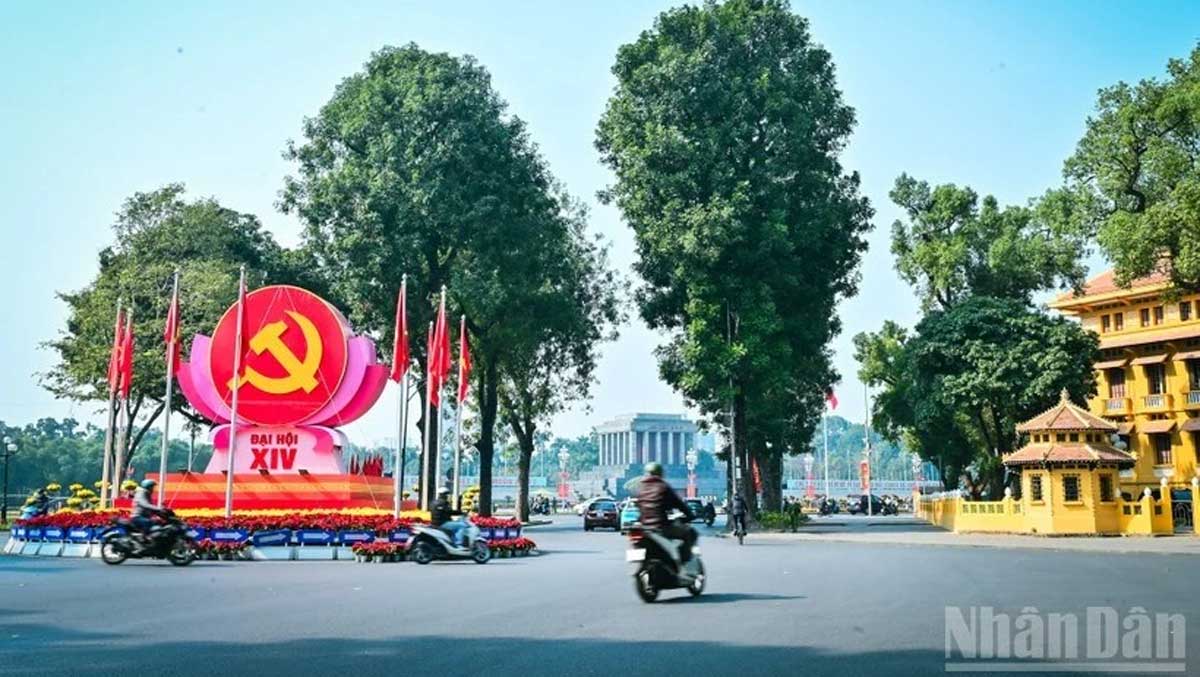
FINANCIAL CHRONICLE – Vietnam is preparing to host the 14th Party Congress on January 14, marking four decades of growth and progress since the launch of the Doi Moi (renewal) economic reform. In 2025, Vietnam’s economy expanded by 8.01%, reaching an estimated $514 billion, positioning it as the 32nd largest economy globally.
From 2021 to 2025, Vietnam’s growth averaged 6.1%, with a per capita GDP of $5,026, classifying the nation among upper middle-income countries, according to information from an online portal dedicated to the Party Congress.
The Party Central Committee has adhered to President Ho Chi Minh’s vision of creating a state “of the people, by the people, and for the people.” This philosophy, coupled with the lessons learned from 40 years of renewal, has shaped policies with innovative thinking. Vietnam embarked on its Doi Moi economic strategy in 1986, and the upcoming 2026 14th Party Congress coincides with nearly four decades of this transformative economic journey.
Initially, the economy, valued at $16 billion in 1985, contracted to $6.39 billion as the Vietnam dong depreciated, according to World Bank data. Today, Vietnam stands as a free-trading nation where businesses compete with imports to offer the best quality and prices to the populace. Products that succeed domestically can compete globally.
Economic Stability
Party General Secretary To Lam has urged the Government’s Party Committee to direct the Ministry of Finance and other relevant agencies to prioritize macroeconomic stability and inflation control to attract both domestic and foreign investment for national development. “High growth must be built on a foundation of stability, with macroeconomic stability and the maintenance of major economic balances as top priorities,” the report indicated.
General Secretary To Lam emphasized that while the state economy will play a guiding role, the private sector is the most critical driver of the national economy. He called for effective management and utilization of state capital in enterprises, as well as the development of international financial centers, free trade zones, and digital assets.
Science and Technology, Lean Government
The new growth model will be propelled by science, technology, and a streamlined government structure. Science, technology, innovation, and digital transformation have been identified as the primary engines for new development and growth models, essential for achieving long-term double-digit growth, according to the party leader.
In 2025, Vietnam reformed its administrative structures to a ‘two-tier’ model, eliminating district administration to create a leaner state. “At the core is a decisive shift from an administrative management mindset to one focused on service, development facilitation, and modern governance; alongside the identification of new driving pillars, including breakthroughs in the development of science and technology,” the portal noted.
These reforms aim to reduce legal compliance costs and foster a transparent and favorable investment and business environment for all economic sectors in line with the Politburo’s guidelines and directions. A development model driven by science and technology is not only an economic necessity but a comprehensive strategic issue. It involves enhancing governance, institutions, developing human capital, ensuring national defense and security, and elevating Vietnam’s international standing.
This strategic path is essential for realizing the country’s goals set for 2030 and 2045, and for building a peaceful, independent, democratic, prosperous, civilized, and happy Vietnam, as stated by General Secretary To Lam. (Colombo/Jan19/2026)