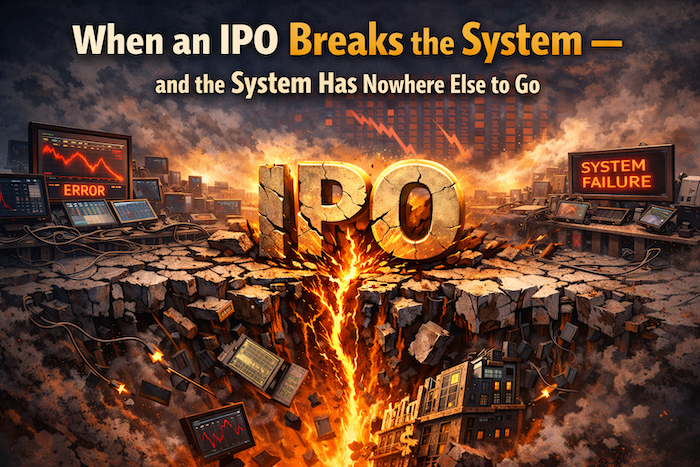
Markets are meant to discover price. Last week, Sri Lanka’s stock market briefly discovered something more awkward: the limits of its own plumbing.
On the debut day of a new IPO priced at Rs. 7, shares managed—within minutes—to trade at levels exceeding Rs. 25,000, a rise north of 3,500 per cent. Screens lit up. Turnover figures ballooned into fantasy. Trading was halted. And by the end of the day, regulators took the rare but necessary step of cancelling all trades.
The official explanation has focused—correctly—on an “erroneous trade”, on gaps in IPO-day safeguards, and on the need to preserve market integrity. All true. But incomplete.
Because this episode did not occur in a vacuum. It occurred inside a system that, for all practical purposes, has no competition.
Sri Lanka’s stockbrokers operate in what is described as a free market, but when it comes to the trading infrastructure itself, they face a classic Hobson’s choice. There is one dominant system—Atrad—and every broker must use it. Not because it is perfect. Not because it is the best available. But because there is no alternative.
For that privilege, each broker reportedly pays around Rs. 18 million annually. In a competitive market, such a fee would buy excellence, redundancy, constant upgrades, and relentless scrutiny. In a monopolistic one, it risks buying something else: familiarity.

And familiarity, in systems that underpin financial markets, can quietly morph into complacency.
This is not an accusation. It is an observation borne of experience. Where there is no competitive pressure, innovation slows. Where there is no threat of substitution, urgency dulls. And where everyone is locked into the same system, responsibility becomes diffuse—someone else’s problem, until it suddenly becomes everyone’s.
The IPO incident raises an uncomfortable but necessary question: did structural lethargy play a role?
Price-band protections that apply to ordinary trading do not automatically extend to IPO debut days.
Buying-power checks appear to have been insufficient to block a transaction of absurd scale. Extreme orders were allowed to print before human or automated intervention kicked in. None of this suggests malice. But it does suggest a system designed for normal conditions—operating in a market that is anything but.
When safeguards fail simultaneously, the issue is rarely a single keystroke. It is design.
To be clear, the regulator was right to act. Cancelling trades was not an overreaction; it was a reset. Leaving a 3,500 per cent price print on the books would have institutionalised nonsense and misled investors who mistake screens for signals. In that sense, the referee did exactly what the rulebook requires.
But good refereeing does not absolve the stadium from having faulty floodlights.
The deeper issue is whether Sri Lanka’s market infrastructure has become too centralised, too comfortable, and too unchallenged. When brokers have no choice of system, complaints become private grumbles rather than market signals. When upgrades depend on a single provider, delays are tolerated. When accountability is shared by everyone, it is owned by no one.
And when something breaks, the explanation defaults to “error” rather than “structure”.
This matters because Sri Lanka’s equity market is at a delicate stage. Retail participation is rising, driven by falling interest rates and a search for yield outside traditional savings. New investors are more vulnerable to spectacle than analysis. They respond to screenshots, WhatsApp messages, and dramatic percentage gains. In such an environment, systems must be more robust than average—not less.
Market integrity is not just about rules and enforcement. It is about confidence that the machinery itself is fit for purpose. A market where prices can momentarily leap thousands of per cent due to a systems gap—even if corrected later—invites doubt. And doubt, once seeded, spreads faster than any erroneous trade.
None of this is an argument against technology. Nor is it a call for endless regulation. It is an argument for choice, competition, and accountability in market infrastructure. Free markets function best when their plumbing is not monopolised, opaque, or taken for granted.
If brokers are paying Rs. 18 million a year for a system they cannot opt out of, the bar should be exceptionally high. Not adequate. Not functional. Exceptional.
The IPO incident should therefore be treated not just as a regulatory lesson, but as a structural one. Fix the IPO-day rules. Tighten order validation. Improve surveillance. Yes. All necessary.
But also ask the harder question: is a market truly free when its most critical system has no competition?
Because if lethargy and complacency are allowed to creep into the foundations, no amount of reactive regulation will fully protect market integrity. And the next time a price defies gravity, the problem will not be the number on the screen.
It will be the system that allowed it to appear there at all.
Markets forgive volatility. They do not forgive fragility.
And integrity, once questioned, is far harder to restore than a cancelled day’s trades.