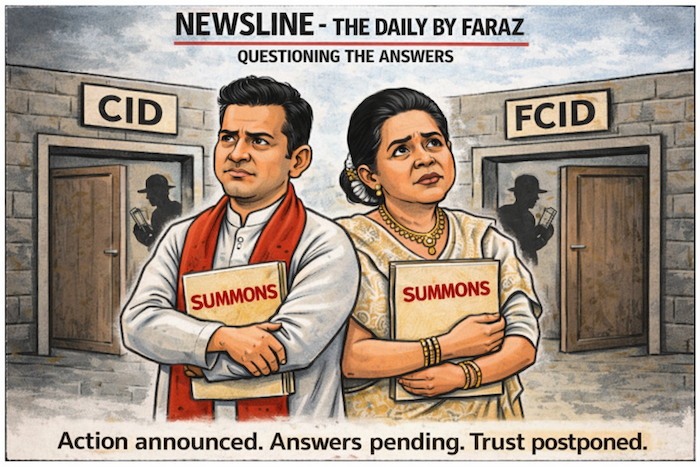
Sri Lanka does not suffer from a shortage of investigations. It suffers from a shortage of conclusions.
Every time a high-profile name is summoned, the State signals motion. Files move. Statements are taken. Cameras roll. Social media erupts. And yet, the public reaction is no longer excitement or relief. It is apprehension.
Not because people oppose accountability — but because they have learned, the hard way, to distrust its choreography.
A Trust Deficit That Will Not Heal Itself
The public mood today is not one of hysteria. It is one of weariness.
Across platforms and conversations, the sentiment is consistent:
We have seen this before.
Investigations begin loudly and then recede quietly. Timelines dissolve. Responsibility blurs. Outcomes are postponed until memory itself becomes the accomplice.
The result is a deepening trust deficit — not only in political actors, but in the very machinery of justice.
That deficit does not arise from cynicism. It arises from experience.
Action Without Explanation Is No Longer Credible
The era when a summons alone satisfied public expectation is over.
Sri Lankans today demand more than action. They demand explanation.
What exactly is under investigation? Who else is being examined — and why?
What evidentiary standard applies? What is the timeline for resolution?
These are not unreasonable questions. They are the minimum requirements of legitimacy.
When authorities act but refuse to explain, the vacuum fills itself — with speculation, suspicion, and selective narratives. Silence, in such cases, is not neutrality. It is abdication.
A Divided Public — But Not a Tribal One
It would be convenient to dismiss the current public reaction as partisan noise. That temptation must be resisted.
The division visible today is not between political camps. It is between those who still believe the system can deliver justice and those who fear it no longer knows how.
One group insists — rightly — that no individual should be above scrutiny, and that the law must be allowed to take its course.
The other points — equally rightly — to a long trail of unfinished cases, selective momentum, and accountability that seems to stall just short of consequence.
This is not polarisation. It is a confidence split.
The Real Damage of Unfinished Justice
An investigation that does not conclude is worse than one never begun.
It damages the innocent by prolonging suspicion.
It weakens the guilty by allowing delay to masquerade as defence. And it erodes the credibility of institutions meant to stand above politics.
Most dangerously, it teaches the public that justice is something that can be managed, timed, or outwaited.
That lesson corrodes democracy far more efficiently than corruption itself.
What the Public Is Asking — Plainly
The demand is not for vengeance. Nor for political theatre.
Nor even for immediate outcomes.
It is for clarity, consistency, and closure.
Sri Lankans want to know that investigations are: comprehensive, not selective,
explained, not merely announced,
and concluded, not endlessly “ongoing”.
This is not a radical demand. It is a civic one. The Question That Refuses to Leave
Until investigations begin to end as clearly as they begin, every new summons will deepen doubt rather than restore confidence.
And the question the public keeps asking — quietly, persistently, without malice — will continue to hang over the system:
Is justice being pursued… or merely being performed?
In a country already exhausted by economic pain and institutional drift, that distinction is no longer theoretical.
It is decisive.