In a country where tourism often oscillates between boom and uncertainty, one name keeps resurfacing with stubborn consistency: Ella.
Why?
It is not a metropolis. It does not have five-star skylines. It does not sell neon nightlife or beachfront excess. Be that as it may, Ella endures. The answer lies not in spectacle, but in restraint.
Green Over Concrete
Ella’s appeal is visual before it is verbal. Mist over tea plantations. The iconic Nine Arches Bridge framed by jungle. Sunrise over Little Adam’s Peak. Hikers silhouetted on Ella Rock.
The architecture has not yet suffocated the landscape.
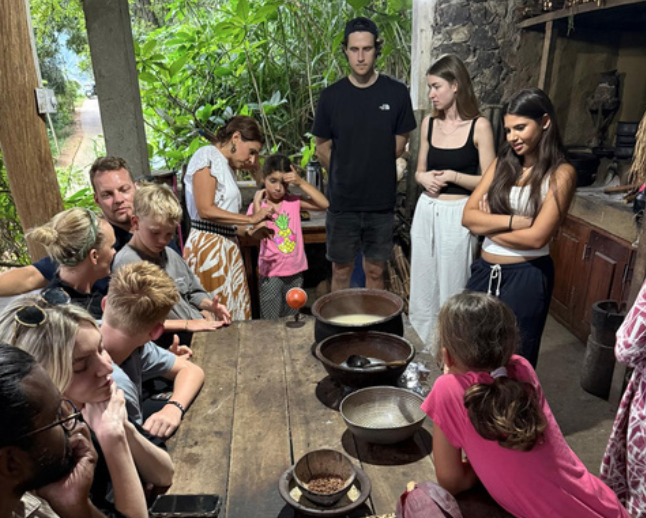
Cooking local in a natural kitchen
Yes, guesthouses multiply. Yes, boutique hotels expand. And fabulous tree houses offer alternative and real green stays. But compared to other global destinations that paved paradise for car parks, Ella still feels breathable.
And breathability is currency.
The Sustainability Signal
Ella does not market itself aggressively as an eco-capital. It does something subtler. It functions — largely — as one.
Short hikes instead of jet skis. Tea estate walks instead of mall floors. Train journeys through hills instead of highway rush.
Tourists increasingly seek experiences that feel less extractive and more immersive. They want landscape, not just infrastructure. They want authenticity, not just amenities.
Ella offers scale without sprawl.
That matters in 2026.
Sustainable tourism is not a slogan anymore. It is an expectation. Travellers — particularly younger ones — are acutely aware of carbon footprints, environmental degradation, and overtourism backlash in destinations from Bali to Barcelona.
Ella, by comparison, feels gentler.
The Train Effect
There is also the romance factor.
The train from Kandy to Ella — often cited as one of the most scenic rail journeys in the world — does more than transport. It frames the journey as part of the destination.
Slow travel, in an era of speed.
The act of leaning out of a carriage for a photograph over the Nine Arches Bridge is almost ritualistic now. But ritual builds memory.
And memory builds loyalty.
Instagram Meets Intimacy
Let us not ignore the algorithm.
Ella photographs beautifully. Mist. Hills. Waterfalls. Tea. Trains. The visual language is soft, organic and shareable. In a tourism economy increasingly driven by digital exposure, Ella performs.
Be that as it may, it has not yet felt industrial. That balance — photogenic yet intimate — is rare.
The Risk Ahead
But endurance is not permanent.
If unregulated development accelerates, if hillsides give way to concrete blocks, if sewage outpaces planning, if roads choke with unmanaged traffic, Ella will become what it currently avoids: another overbuilt cautionary tale.
Sustainability is not aesthetic. It is policy.
Local authorities and national planners must recognise that Ella’s value lies precisely in what it has not done. The temptation to monetise every slope must be resisted.
Green is not weakness. It is competitive advantage. The Broader Lesson
Ella’s success is instructive for Sri Lanka’s wider tourism strategy.
High-value tourism does not require maximal construction. It requires preservation. It requires infrastructure that complements landscape, not conquers it.
Sri Lanka’s comparative advantage is ecological diversity — rainforest to reef, tea to temple. The more we preserve that diversity, the more resilient our tourism product becomes.
Ella is not perfect. It is not pristine. But it represents something increasingly rare in global tourism: scale without suffocation.
That is why it endures. Not because it is flashy. But because it still feels real.
And in a hyper-commercial world, reality is premium.