Why Kamindu Mendis Should Not Have to Declare His Bowling Arm

by

in

Cricket has quietly accepted that modern batting is built on freedom of choice. A batter can reverse sweep, switch hit or change stance at the last moment without informing the umpire or the bowler. These decisions can completely reshape angles, fields and match-ups, yet the game trusts skill and reaction to settle the contest.

That same trust, critics argue, is missing when it comes to bowlers—especially in the case of Kamindu Mendis.

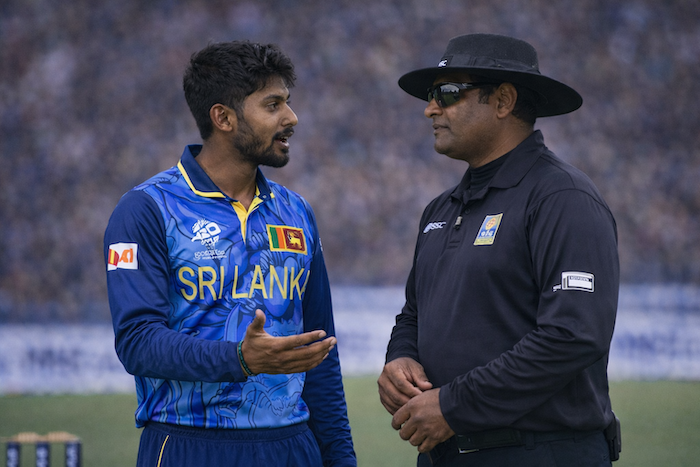
Mendis is one of international cricket’s rare ambidextrous bowlers, capable of delivering right-arm off-spin and left-arm orthodox with control and intent. However, under current laws, he must inform the umpire every time he switches his bowling arm, a requirement that effectively alerts the batter in advance and removes any element of uncertainty.

The contrast with batting is stark. A reverse sweep fundamentally alters the contest, often late in the delivery, yet it requires no declaration. The bowler simply has to adjust. In Mendis’ case, the batter can clearly see which arm he is bowling with well before release, meaning the contest remains fair and transparent. Requiring advance notice, opponents of the rule argue, enforces predictability rather than fairness.

Kamindu Mendis is an ambidextrous bowler who can deliver both right-arm off-spin and left-arm orthodox, but under cricket’s laws he must inform the umpire whenever he switches bowling arms. This requirement exists to ensure clarity for umpires in judging the legality of the delivery, bowling side and fielding positions, and to avoid confusion for the batter, as a change of arm is treated as a fundamental change in the bowling action rather than a last-moment tactical choice.

Ashwin Questions Bowling Restrictions as Pause Debate Reignites
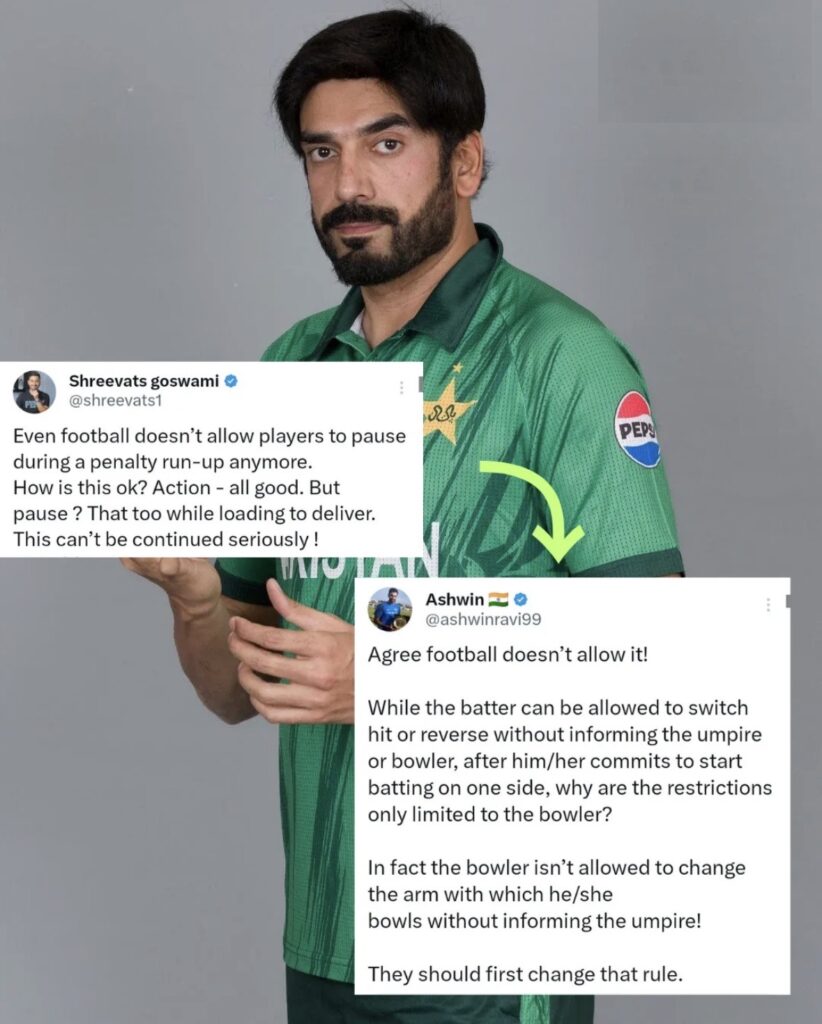
The debate gained wider attention following a tweet by Indian spinner Ravichandran Ashwin, responding to criticism of bowlers pausing in their run-up. While acknowledging that football does not allow pauses during penalty kicks, Ashwin cautioned against applying football’s logic to cricket. More pointedly, he highlighted the imbalance in cricket’s laws: batters are allowed to change intent mid-delivery without informing anyone, while bowlers are restricted even before the ball is bowled.
In cricket, the Laws of the Game allow a batter complete freedom in shot selection and movement at the crease, meaning they may change stance, play a switch hit or execute a reverse sweep without informing the umpire or the bowler. There is no requirement for prior declaration of intent, even if the decision is made late in the delivery, and such actions are treated as legitimate batting skill rather than deception.
In football (soccer), the Laws of the Game specifically govern what a player can and cannot do when taking a penalty kick. Under current rules, a player may make deceptive movements or even pause in their approach during the run-up, but once they reach the ball and begin the final kicking motion, feinting to kick the ball at that point is considered an infringement and can lead to a caution or an indirect free kick if judged unsporting.

Ashwin’s tweet did not explicitly mention Mendis, but it reinforced the same principle. If cricket permits a batter to reverse sweep after committing to a stance, it should permit a bowler to choose which arm to bowl with—so long as the action is legal and visible.

As cricket continues to evolve, Kamindu Mendis has become a symbol of a broader question facing the sport: can innovation be celebrated on one side of the contest while being regulated on the other? Ashwin’s comments have only sharpened that question, pushing administrators to reconsider whether the laws truly offer parity between bat and ball.



Latest News


  • Hayleys PLC Honored with Excellence Award at CA Sri Lanka’s TAGS Awards Diamond Chapter 2025

    Hayleys PLC Honored with Excellence Award at CA Sri Lanka’s TAGS Awards Diamond Chapter 2025

    The conclusion of a landmark event celebrating corporate excellence, the prestigious TAGS Awards, marked its 60th anniversary with a grand finale that honored a wide range of organizations, from top corporates to SMEs, for their outstanding corporate reporting achievements. Organized by the Institute of Chartered Accountants of Sri Lanka (CA Sri Lanka), the Diamond Chapter

    Read more


  • Sinopec Expands Eco-Friendly Network with Revamped Stations in Anuradhapura, Sri Lanka

    Sinopec Expands Eco-Friendly Network with Revamped Stations in Anuradhapura, Sri Lanka

    Sinopec has reaffirmed its commitment to enhancing Sri Lanka’s energy infrastructure and community standards by completing upgrades to three fuel stations and introducing a new station in Anuradhapura. This development marks a significant milestone in the company’s nationwide expansion in support of the national Clean Sri Lanka initiative. The stations, located in Eppawala, Srawasthipura, New

    Read more