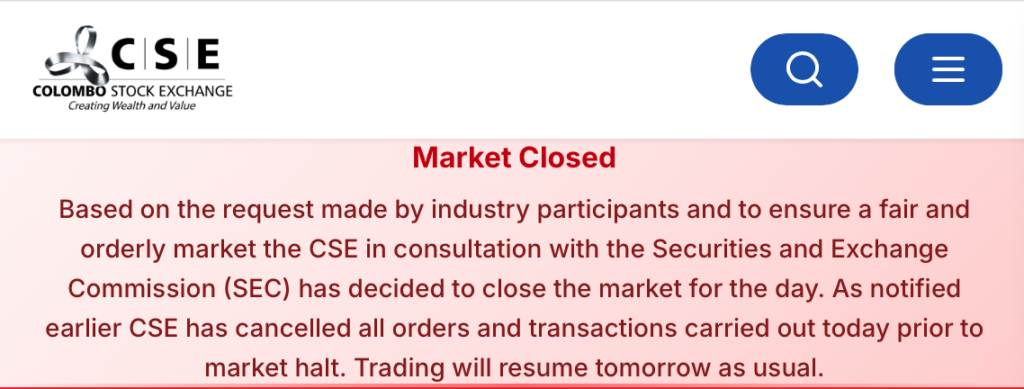
Colombo, January 2026 — The trading suspension at the Colombo Stock Exchange (CSE) on 7 January 2026 has once again exposed a structural vulnerability that has little to do with a single incident and everything to do with concentrated technology risk. Regardless of whether the day’s disruption was caused by human error, inadequate controls or market behaviour, the outcome was the same: the entire market came to a standstill, trades were cancelled, and confidence took a hit.
At the centre of the debate is the CSE’s long-standing dependence on a single dominant trading software ecosystem, primarily accessed by brokers through IronOne Technologies’ ATrad platform. While IronOne itself is a reputable, privately owned technology company with international operations, ISO certifications and a strong engineering pedigree, the issue is not the competence of one vendor — it is the systemic risk of reliance on one.
Single point of failure in a fragile market
Modern stock exchanges are considered critical financial infrastructure. Globally, they are designed to withstand not just cyberattacks and hardware failures, but also operational mistakes and extreme market behaviour. This resilience is achieved through redundancy, vendor diversity and layered risk controls. By contrast, Sri Lanka’s market structure leaves little room for error. When a single ecosystem dominates broker connectivity, any disruption — technical or otherwise — is amplified across the entire market.
For a small and already liquidity-constrained exchange, this concentration risk is particularly dangerous. A single halted session can distort price discovery, undermine investor trust and reinforce perceptions that the market is operationally fragile.
Costs, competition and innovation
Broker firms have long raised concerns — mostly privately — about high access and software costs associated with a near-monopoly technology environment. Elevated fixed costs discourage new entrants, weigh on smaller brokerages and ultimately limit market depth. More importantly, a lack of competing platforms reduces pressure to innovate, improve user experience, or rapidly introduce advanced risk-management features such as dynamic price collars, real-time fat-finger controls and automated kill switches.
In global markets, exchanges often certify multiple front-end systems, allowing brokers to choose between vendors while the exchange retains control over the core matching engine and surveillance. This model promotes competition without compromising regulatory oversight.
Diversification, not scapegoating
It is important to note that there is no public evidence that IronOne or its owners are politically connected, nor that the January 7 disruption was caused by a software failure attributable to the vendor. Calls to reform the CSE’s technology framework should therefore not be misread as an attack on one company. Instead, they reflect a broader recognition that no single provider — however capable — should represent a systemic choke point in a national capital market.
Decommissioning an existing platform overnight would be reckless. What is needed is a measured transition: an independent post-incident review, strengthened pre-trade controls, clearer service-level benchmarks, and a roadmap to onboard multiple certified trading technology providers.
A question of credibility
Ultimately, the issue is one of credibility. As Sri Lanka seeks to attract foreign investors, revive domestic participation and modernise its financial system, operational resilience is non-negotiable. Technology diversification is not a luxury or an ideological preference; it is basic risk management.
The lesson from January 7 is clear: even when markets appear stable on the surface, hidden structural weaknesses remain. Addressing technology concentration at the CSE would be a decisive step toward building a more resilient, competitive and credible capital market — one that does not grind to a halt when a single link in the chain fails.