When a Sri Lankan President Oversaw Britain’s Monarchical Reaffirmation
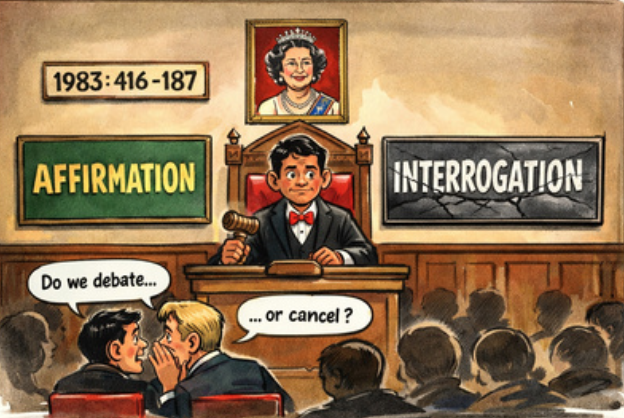
In February 1983, the Oxford Union revisited one of the most controversial motions in its history:
“This House would not fight for Queen and Country.”
Fifty years earlier, in 1933, the motion had passed — stunning the British establishment and feeding fears of elite pacifism in the shadow of gathering European storms.
In 1983, the result was emphatic.
416 against.
187 in favour.
The motion was defeated.
Britain, it seemed, would stand.
What makes the 1983 debate particularly intriguing is this: it took place during Hilary Term 1983, when the President of the Oxford Union was Hilali Noordeen of Balliol College — a Sri Lankan.
Sri Lanka had by then long ceased to be Ceylon. It had become a republic in 1972. The British monarch was no longer its head of state. Yet the chamber that evening — presided over during Noordeen’s term — became the stage for a forceful reaffirmation of British loyalty to Crown and country.
History has its ironies.
Britain in 1983
Context matters.
The Falklands War had been fought and won the year before. Margaret Thatcher’s government was riding a wave of restored national confidence. Queen Elizabeth II’s approval ratings were widely reported in the high 80 percent range.
The monarchy was not under siege. It was a symbol of continuity.
The 1983 vote was not merely procedural. It was cultural. It signalled that Britain’s intellectual youth — often caricatured as rebellious — aligned with the prevailing mood of national resolve.
The Union chamber did not fracture. It consolidated. Fast Forward to Now
Would Oxford vote the same way today? Britain in the 2020s is a different country.
The Charles–Diana rupture fractured public mythology. The Andrew scandal damaged moral authority. The transition to King Charles III has been steady but quieter, less insulated from scrutiny.
Polling today suggests majority support for the monarchy remains — but nowhere near the near-unassailable levels of the early 1980s. Among younger demographics, scepticism is pronounced.
Institutional loyalty is no longer assumed. It is debated. The Deeper Shift
The significance of 1983 was not monarchism alone. It was institutional confidence.
In 1933, the Union’s vote reflected doubt.
In 1983, it reflected affirmation.
In 2026, a similar motion would unfold in a hyper- transparent, socially fragmented, post-imperial environment. The debate would likely pivot toward constitutionalism, accountability and national identity in a globalised world.
It might still defeat the motion.
But it would not do so with the same uncomplicated certainty. A Final Irony
That the 1983 reaffirmation of “Queen and Country” took place under the presidency of a Sri Lankan student is more than a footnote.
It speaks to the layered complexity of Commonwealth history — where former colonies and former imperial centres continue to shape one another’s narratives.
The Oxford Union chamber has always reflected the mood of its moment.
The question now is not whether Britain would fight for Queen and Country. It is whether Britain believes in its institutions with the same clarity it did in 1983.
And that answer may be far less decisive.