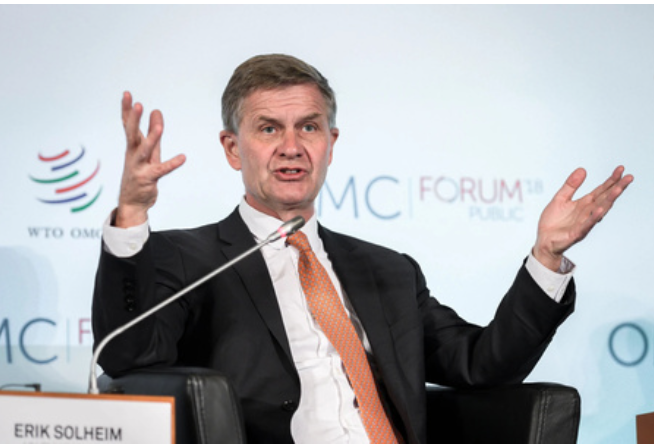
Eric Solheim did not speak about plastic as an environmental accessory.
He spoke about it as an economic liability Sri Lanka can no longer afford.
At Kandalama, amid discussions on sustainable tourism, Solheim’s most pointed intervention was deceptively simple: a country that markets paradise while exporting plastic into its rivers, beaches, and villages is liquidating its brand in real time.
Zero plastic, he argued, is not a campaign. It is a threshold.
Sri Lanka likes to think of plastic pollution as a cosmetic failure — an eyesore to be cleaned up before a tourist season, a beach to be photographed after a volunteer drive. Solheim’s warning was sharper: plastic is no longer just litter; it is reputational damage.
In a global tourism market increasingly shaped by conscience as much as cost, destinations are judged not by slogans but by consistency. A plastic bag in a mangrove, a PET bottle floating in a lagoon, or polythene lining a roadside does not register as a local governance failure. It registers as a national one.
And tourists, unlike development partners, do not issue warnings before walking away.
Plastic as Economic Leakage
Solheim’s most uncomfortable point was also his most practical. Plastic is not merely an environmental pollutant; it is a form of economic leakage.
Every piece of single-use plastic imported, discarded, and unmanaged carries hidden costs: cleanup, health impact, ecosystem damage, and loss of tourism value. These costs do not appear neatly in Budget speeches, but they surface later — in declining destination appeal, shorter stays, and lower spending.
Sri Lanka, he suggested, is paying repeatedly for plastic — first to import it, then to manage it badly, and finally through lost opportunity.
Zero plastic, therefore, is not about purity. It is about efficiency.
From Applause to Enforcement
Solheim was careful not to romanticise the challenge. Zero plastic does not happen through hashtags, pledges, or ceremonial bans. It requires boringly effective governance:
enforcement, alternatives, pricing signals, and accountability.
Sri Lanka has announced plastic restrictions before. What it has lacked is follow-through. Weak enforcement has trained both consumers and businesses to treat bans as temporary inconveniences rather than binding rules.
Solheim’s message was blunt: partial compliance is indistinguishable from failure.
Countries that have succeeded did not rely on goodwill alone. They combined regulation with incentives, nudging markets toward biodegradable alternatives, reuse systems, and circular models. Plastic reduction worked where it was made cheaper to comply than to cheat.
Tourism Cannot Carry the Plastic Burden Alone
Another subtle but critical point: the tourism sector cannot be the only clean island in a plastic sea.
Expecting hotels and resorts to maintain zero-plastic standards while surrounding towns, supply chains, and transport systems remain saturated with waste is both unfair and ineffective. Sustainability cannot be zoned.
This is where Sri Lanka’s policy fragmentation becomes self-defeating. Environmental regulation, local government waste management, import policy, and tourism promotion operate in parallel — rarely intersecting.
Solheim’s argument was that zero plastic must be national, not cosmetic. Otherwise, it becomes performative sustainability — impressive on brochures, fragile in reality.
The ZeroPlastic Movement: Proof of Possibility
Solheim pointed to Sri Lanka’s own ZeroPlastic movement as evidence that ambition exists on the ground. Community-led cleanups, advocacy, and education have shown what is possible when commitment is real. Even Nishanka De Silva’s ZeroPlastic Movement of over 12,000 University students is not quite enough commendable as it is. The initiative to force plastic shopping bags to be sold at Rs 5 a piece was a singular victory for the movement, for the country as a whole.
But volunteers cannot substitute for the State. Movements can inspire. Only governments can scale. Zero plastic, Solheim stressed, requires political backing strong enough to inconvenience entrenched interests — importers, distributors, and manufacturers who benefit from plastic’s artificial cheapness while externalising its costs onto society.
The Hard Truth
The hardest truth Solheim left Sri Lanka with was this: zero plastic is not radical — delay is. Every year of hesitation deepens the clean-up bill, erodes natural capital, and weakens the tourism proposition. Plastic does not wait for consensus. It accumulates.
Sri Lanka’s choice is no longer between development and environment. That false binary has expired. The choice is between orderly transition and managed decline.
Zero plastic will not win instant applause. It will irritate vendors, disrupt habits, and demand enforcement muscle the State has historically been reluctant to use.
But it will also do something far more valuable.
It will protect what Sri Lanka sells to the world — and what it owes its own people.
Eric Solheim did not come to preach environmental virtue. He came to issue an accounting warning. Plastic is cheap only until you add up the cost.
And Sri Lanka’s bill is already overdue.