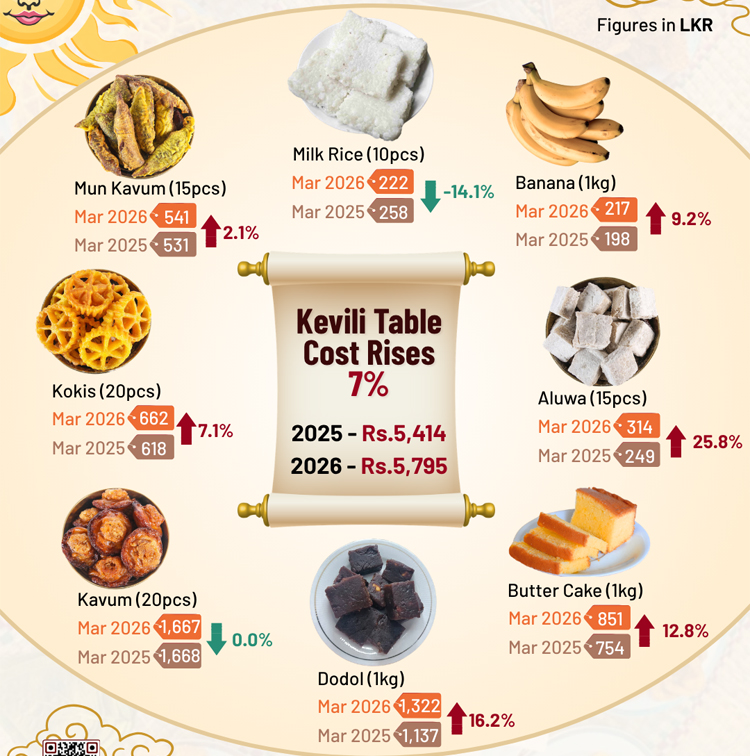
The price of a traditional kevili table, a staple during the Sinhala and Tamil New Year festivities, has seen a 7% increase in 2026 compared to the previous year, 2025.
A kevili table, which is a customary part of the New Year celebrations in Sri Lanka, features a variety of traditional sweets that represent prosperity and joy.
This year, prices for six out of the eight components that make up the kevili table have risen. The most significant increase was observed in aluwa, which surged by 25.8%, largely due to a 43.6% rise in the cost of cashews. In contrast, milk rice experienced the largest decrease, dropping by 14.1%, primarily influenced by a 17.5% decline in coconut prices from the exceptionally high figures recorded in 2025.
The overall increase in the cost of the kevili table for 2026 is largely attributed to rising prices of coconut oil and rice flour, which together contributed to nearly 80% of the total price hike.
Moreover, when compared to 2019, which was prior to the economic crisis, the cost of a kevili table has more than doubled, increasing by 2.5 times by 2026.
Exhibit 1 illustrates the price changes of kevili items over time (prices in LKR).
Note: While variations exist among households, a typical kevili table consists of milk rice, kokis, banana, aluwa, kevum, dodol, mun kevum, and butter cake. This analysis is based on recipes from the widely recognized YouTube channel Appe Amma, adapted for a household of four to five individuals. Only the primary ingredients have been considered in the cost estimate, excluding utility expenses such as electricity or gas and spices.
Sources: Price data were obtained from the Department of Census and Statistics, particularly from the Open Market Weekly Average Retail prices in the Colombo District for the years 2019 (April, Week 1), 2025 (March, Week 3), and 2026 (March, Week 4).
Financial Chronicle Biz English | Sri Lanka Business News.