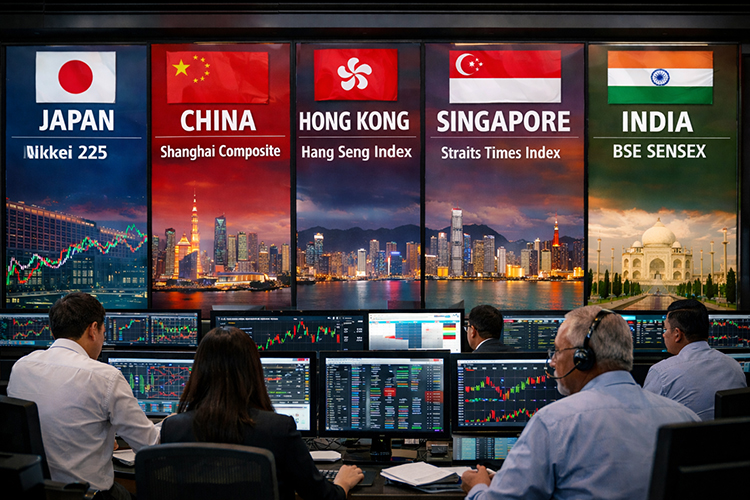
Asian stocks experienced instability on Wednesday, mirroring steep declines in U.S. and European equities amid concerns that advancements in artificial intelligence might replace traditional software solutions. Meanwhile, oil prices rose following the U.S. military’s action against an Iranian drone and the approach of armed boats towards a U.S.-flagged vessel in a crucial maritime route. Precious metals also regained some stability after a recent downturn.
The selloff in U.S. and European data analytics, professional services, and software companies intensified after Anthropic launched plug-ins for its Claude Cowork agent last Friday, raising fears of AI-driven disruptions within these sectors. However, the selling pressure in Asia was less severe due to the region’s historical dominance in hardware manufacturing. MSCI’s broadest index of Asia-Pacific shares outside Japan declined by 0.2%, while Japan’s Nikkei dropped by 1.23%.
Nasdaq futures decreased by 0.25% following a loss of more than 1% in the previous session, while S&P 500 futures were down 0.1%. EUROSTOXX 50 futures dipped by 0.07%.
“The AI trade is splitting between relative winners and losers,” remarked Ben Bennett, head of investment strategy for Asia at L&G Asset Management. “We observed this last week when Microsoft shares fell despite solid results due to concerns about disruptions to its software business. This software instability has persisted this week, indicating that the tech sector will not uniformly benefit but will have some weak areas as well.”
South Korea’s technology-heavy KOSPI fell by 0.14%, while stocks in Taiwan decreased by 0.68%.
In the oil market, Brent crude futures rose by 1% to $68.03 per barrel, and U.S. crude increased by 1.1% to $63.90 per barrel, as recent events heightened concerns that U.S.-Iran tension de-escalation talks could be disrupted. The U.S. military reported shooting down an Iranian drone that “aggressively” approached the Abraham Lincoln aircraft carrier in the Arabian Sea. Additionally, a group of Iranian gunboats approached a U.S.-flagged tanker in the Strait of Hormuz, a key passage for crude exports from several OPEC members.
Precious metals showed signs of recovery from a downturn. Spot gold rebounded to the $5,000 level, increasing by 1.5% to $5,014.31 an ounce, while silver rose by 1.7% to $86.57 an ounce. The recent decline followed U.S. President Donald Trump’s announcement of Kevin Warsh as his pick to lead the Federal Reserve and a margin hike by CME, which exacerbated the selloff. Warsh is anticipated to reduce the Fed’s balance sheet, typically impacting non-yielding precious metals negatively.
“We anticipate elevated volatility in the short term, but stabilization should return once the market finds its footing,” stated Joshua Chim, general manager of online broker FSMone. He noted that retail investors on the platform were “buying the dip via unit trusts or ETFs” following the “significant correction” in gold and silver prices.
Currency movements were more subdued on Wednesday, with the dollar halting its recent rally spurred by the Warsh announcement. The yen weakened, falling to over 156 per dollar, ahead of an upcoming lower house election in Japan that could grant Prime Minister Sanae Takaichi a stronger mandate to implement tax cuts and expanded stimulus.
The euro was last traded at $1.1821, while sterling stood at $1.3710. In the cryptocurrency market, Bitcoin lingered near its lowest level since November 2024, rising just 0.6% to $76,658.96 after losing 2.9% on Tuesday.
“The market structure has weakened significantly since October,” commented Manuel Villegas Franceschi from Julius Baer’s next-generation research team, noting that Warsh’s nomination was a “tipping point for the crypto drawdown.”
Treasury yields showed little change, with the benchmark 10-year yield at 4.2794%, while the two-year yield stood at 3.5778%. Longer-end yields have edged higher as investors contemplate a Federal Reserve under Warsh, whose preference for a smaller balance sheet could reduce the number of bonds the bank holds. “I don’t think he will necessarily come in and say ‘for sure, we shrink the balance sheet.’ I believe he will make it data-dependent and contingent on developments,” said Christian Nolting, global chief investment officer at Deutsche Bank Private Bank, during a media briefing.