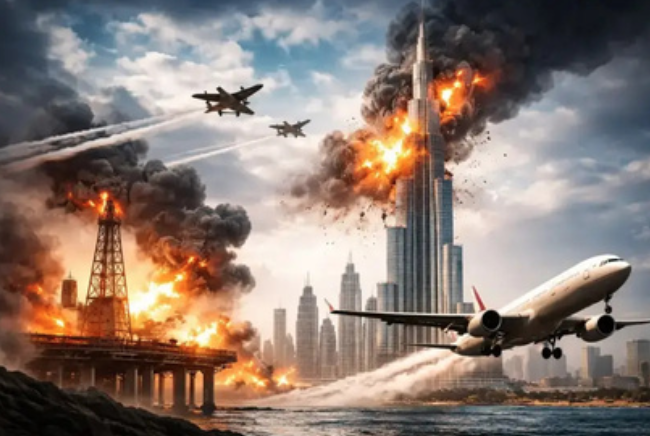
As conflict between the U.S., Israel and Iran intensifies — with direct attacks reaching Gulf soil and key hubs like Dubai feeling the shockwaves — the emirate’s property market and broader economy are entering a phase of heightened uncertainty, cautious recalibration, and potential short-term disruption.
Immediate Impact — Risk Sentiment Over Reality
Dubai has long marketed itself as a stable, globally connected safe haven within a sometimes unstable region. Yet recent missile strikes affecting UAE territory — including near major transport and commercial infrastructure — plus emergency alerts sent to residents, have punctured that perception of untouchable security.
In financial markets, this risk shock is already visible: UAE equities — including real estate leaders — have retreated as investors factor geopolitical risk into asset valuations.
Real estate markets, which rely heavily on confidence and cross-border capital flows, are delicately sensitive to such sentiment shifts. Some analysts warn that transaction volumes may moderate as buyers from India, Europe and Asia take a “wait-and-watch” approach, especially in the off-plan and speculative segments.
This caution is typical: geopolitical uncertainty rarely triggers panic selling, but it does slow deal closures and dampen pricing momentum in near-term quarters.
Medium Term — Confidence Versus Caution
Dubai has absorbed multiple shocks in the past — oil price swings, regional unrest, pandemic disruptions — and its real estate has historically rebounded with robust fundamentals.
However, the medium-term outlook will depend on three keyvectors:
Duration of the conflict: A short standoff may only cause a transient slowdown in deals and modest pricing pressure. A protracted war scenario could see buyers negotiating harder, delaying commitments and reducing speculative activity.
Perceived safety of the UAE: If Dubai and the wider UAE continue to avoid direct sanctions, closures, or further military spillover, they retain their appeal as a neutral economic hub in the Gulf.
Global capital allocation: In times of flight to safety, some investors actually re-allocate to locations seen as politically stable and financially predictable — and Dubai has been positioned as such in many global portfolios.
Economic Strain Beyond Property
The broader Dubai economy is not immune. Airport closures, suspended flights and interrupted trade flows exact a direct economic toll — reducing tourism revenue, aviation earnings and retail footfall — all of which feed into GDP and confidence.
Crucially, the oil price shock stemming from tension around the Strait of Hormuz — with Brent crude surging toward new highs — feeds into operating costs, inflationary pressures, and risk premia that influence everything from construction costs to expatriate living expenses.
Bottom Line — Stabilise, But Watch the Tail Risks
Dubai’s property market is unlikely to collapse simply because of the Iran–U.S.–Israel conflict. Its real strength lies in regulatory frameworks, demographic expansion, economic diversification and global investor networks.
But short-term caution, slower sales cycles and price moderation in select segments are probable if geopolitical risk persists. And in extreme scenarios — with further direct conflict or expanded missile targeting — investor confidence could be markedly dented, pushing capital temporarily toward ultra-safe assets like gold, sovereign bonds or economies perceived as more removed from Middle East volatility.
In other words: Dubai might not be drawn into the war, but it cannot remain completely untouched by its economic and psychological crosswinds.
SEPARATING PSCHOLOGY FROM PROBABILITY
Targeting symbols like Burj Khalifa, Dubai International Airport (DXB), or Palm Jumeirah would be strategically and psychologically enormous — but also extraordinarily escalatory.
Symbolic Shock
The Burj Khalifa is not just a building. It is a global icon of Gulf stability and ambition. Striking it would be designed to shatter investor confidence overnight.
DXB is one of the busiest international hubs in the world. Disrupting it would paralyse aviation flows between Europe, Asia and Africa. Insurance rates would spike immediately. Airspace risk classification would change.
Palm Jumeirah represents luxury capital, foreign buyers, tourism wealth. A strike there would target perception — not military capacity.
In short: such targets are about narrative warfare.
But Here’s the Hard Reality
High-profile civilian landmarks are typically not primary military targets in conventional state-to-state escalation. Military planners focus on:
Bases
Radar systems
Naval facilities Energy infrastructure
The UAE hosts strategic military installations — those would rank higher on any target list.
Direct strikes on purely civilian prestige assets would likely:
Trigger overwhelming retaliation
Expand the conflict regionally
Risk drawing in additional global powers Severely damage diplomatic backchannels
That’s a different level of war. What Is More Likely?
The greater risk is:
Missiles aimed at military sites being intercepted over cities
Drone activity targeting energy or port infrastructure Cyber attacks on aviation and finance systems
Airspace closures affecting DXB without physical damage
Dubai’s strength is layered air defence, early warning coordination with Western allies, and strong infrastructure redundancy.
Bottom Line
A deliberate strike on the Burj Khalifa or Palm Jumeirah would be seismic. But the probability remains low unless the conflict spirals into full regional war.
The greater danger isn’t iconic destruction. It’s sustained instability.
And markets fear instability more than headlines
Daily Life Amid Escalation — Not Normal, But Managed
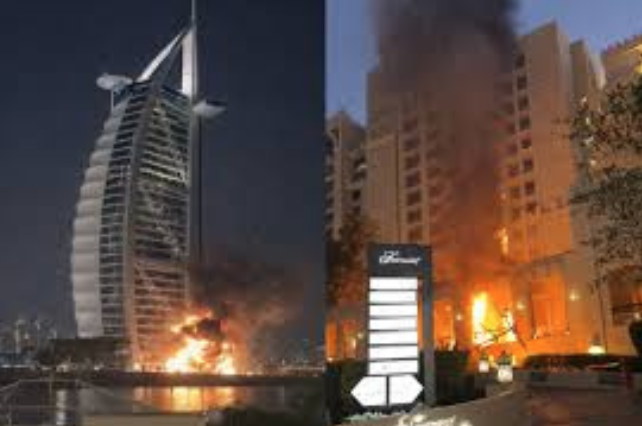
Recent regional escalation involving the United States, Israel and Iran has directly impacted parts of the UAE — especially Dubai and Abu Dhabi — with missile and drone strikes reaching urban areas, causing infrastructure damage and casualties. Airports have been hit, attractions like the Burj Al Arab and Palm Jumeirah have seen fires from debris, and public alerts to “seek shelter” have been issued.
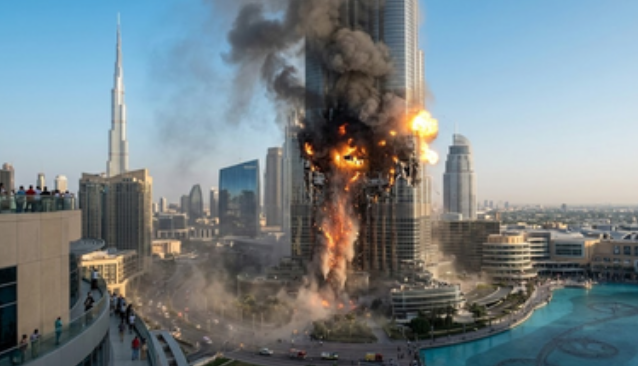
Authorities have activated emergency protocols. Schools and universities have moved to online learning as a precautionary measure to keep children and families safe.
Travel is disrupted: airspace is closed or partially closed, flights are suspended by international carriers, and major hubs like Dubai and Abu Dhabi airports are not operating normally.
Some foreign governments now advise against all non- essential travel to the UAE due to unpredictable security developments.
Life Inside the Emirates
This is not “business as usual,” but it’s also not total breakdown:
Routine activities continue where possible — shops, grocery stores, pharmacies and essential services operate normally in many districts.
Citizens and residents still move about cities, often with elevated vigilance and adherence to government instructions like staying indoors during alerts.
Social media from within the UAE shows people continuing daily tasks, though with visible signs of wariness and preparedness — many sharing safety updates, sheltering in place during alerts, and communicating widely about official guidance.
Precautions & Public Messaging
Local authorities stress robust crisis response capabilities. Government assurances emphasise that security forces are actively monitoring threats and protecting residents.
In official statements and media posts, the focus remains on safety, situational awareness, and following directives from civil defence authorities.
At the same time, foreign government advisories — including from Canada and Australia — note that the situation is volatile and can deteriorate abruptly, recommending sheltering in place and preparation for rapid changes.
Daily life in Abu Dhabi, Dubai, Sharjah, Al Ain and other emirates continues with a blend of routine activity and conflict-related disruption:
• Schools moved online
• Flights grounded or cancelled
• Public safety alerts ongoing
• People reported sheltering indoors during threats
• Essential services and commerce operating where safe
This isn’t normal — it’s controlled abnormality: a society adapting in real time to security risks, anchored by strong civil defence systems but visibly impacted by regional escalation.