Why ₹23,000 tickets sell in a country still struggling with poverty
By Faraz Shauketaly
Be that as it may, to understand India today, one must first abandon the idea that it is a single economy. It is not. It is, in reality, two – and arguably three – economies coexisting within one nation of 1.4 billion people.
This is the only way to reconcile the apparent contradiction: a country where luxury malls are full, global brands thrive, and ₹23,000 IPL tickets sell out – while hundreds of millions still live on fragile, uncertain incomes.
With annual incomes ranging from ₹10 lakh to ₹1 crore and beyond, this group drives the visible face of India’s economic success.
They are the consumers filling shopping malls, buying premium goods, travelling internationally, and sustaining demand for global brands.
This is the India the world sees.
THE STRIVERS
Beneath them lies a second layer – the emerging class.
Numbering between 300 and 400 million people, this segment earns between ₹2 lakh and ₹10 lakh annually. They are not yet affluent, but they are aspirational – gradually upgrading their consumption, moving from necessity to choice.
They are India’s future demand base.
THE FRAGILE MAJORITY And then there is the third India.
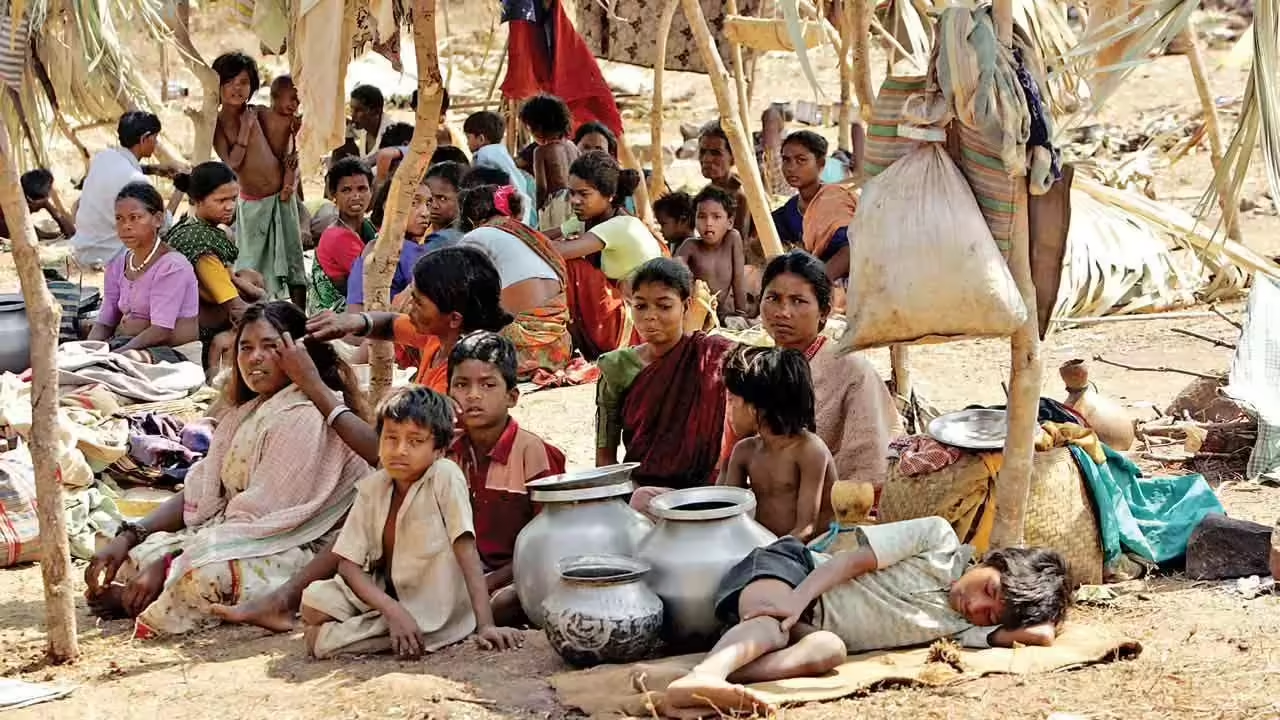
Between 700 and 800 million people, living on less than ₹2 lakh annually, often within the informal economy. Their incomes are unstable, their spending constrained, and their exposure to shocks significant.
This is the India that does not enter the mall.

WHY ₹23,000 IPL TICKETS SELL
The answer lies in scale. Even 5% of India’s population is 70 million people.Within that number sits a consumer base large enough to sustain premium pricing, luxury consumption, and high- value entertainment markets. What appears exclusive is, in India’s context, simply a small slice of a very large base.
WHY MALLS AND GLOBAL BRANDS THRIVE
Companies are not targeting 1.4 billion people.
They are targeting the top 100–200 million consumers, concentrated in major urban centres. That segment alone is comparable in size to entire developed markets.
For business, that is more than sufficient.
THE INFRASTRUCTURE STORY
India’s infrastructure boom – roads, airports, rail, digital networks – is real.
But it is driven primarily by state-led capital expenditure and policy direction, not necessarily by uniform prosperity across the population.
It creates visibility.
It signals momentum.
But it does not, by itself, equal broad-based wealth.
THE CORE TRUTH
Be that as it may, India works not because inequality has been resolved – but because it has been absorbed into a functioning system of scale and aspiration.
200 million drive consumption 400 million are climbing
700 million remain vulnerable
THE CORE QUESTION
Is India’s growth broadening – or simply intensifying at
the top?
NEWSLINE-STYLE TRUTH
Be that as it may, India is not uniformly rich. It is
selectively prosperous at scale.
THE STING
India works because scale, inequality, and aspiration coexist.