Asia’s financial markets experienced an upswing on Wednesday, driven primarily by gains in Korean chipmakers, as investors showed increased confidence in the perceived safety of artificial intelligence (AI) investments. Meanwhile, the Japanese yen remained a focal point for traders.
Amid recent market volatility, investors were also keenly anticipating U.S. President Donald Trump’s State of the Union address scheduled for Tuesday evening in Washington. Market participants were preparing for potential comments on various policies, including trade, affordability, and Iran.
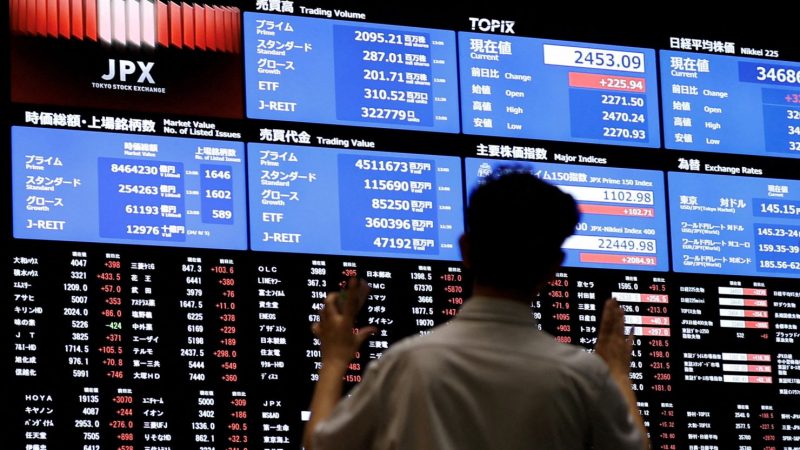
The MSCI’s broadest index of Asia-Pacific shares outside Japan rose by 1% in early trading. In Japan, the Nikkei reached a record high, climbing 1.1% to 57,956.92 after hitting an intraday peak of 58,047.89. The broader Topix index edged up 0.07% to 3,818.73.
Korea’s KOSPI saw a significant increase of nearly 1.7%, surpassing the 6,000 mark for the first time. The index has risen by 44% so far this year. A global memory chip shortage has driven the stock prices of Samsung Electronics and SK Hynix to double since October, as investment capital flowed into the AI supply chain, benefiting these popular chipmakers. Leading global chipmaker Nvidia Corp is set to report its fourth-quarter results after the U.S. market close on Wednesday.
In Hong Kong, the Hang Seng Index increased by 0.36%, while China’s CSI300 climbed 0.3%. Australia’s S&P/ASX200 rose by as much as 1.1% to a record high, despite higher consumer prices in January that raised the risk of further interest rate hikes.
The yen strengthened by 0.12% against the U.S. dollar, reaching 155.7 per dollar on Wednesday, recovering from a 0.8% drop on Tuesday. A report indicated that Japanese Prime Minister Sanae Takaichi expressed concerns about additional interest rate hikes to Bank of Japan Governor Kazuo Ueda, casting doubt on the timing of the next rate increase. The dollar index, which tracks the greenback against a basket of currencies including the yen and the euro, fell by 0.05% to 97.84, with the euro up 0.05% at $1.1777.
A Reuters poll released last week revealed that most economists expect the Bank of Japan (BOJ) to raise its key rate to 1% by the end of June, with some predicting a move as early as April due to inflationary pressures and a weak yen. Traders are currently pricing in a 50% chance of a hike in April and a 65% likelihood by June.
“Given there was an expectation that she would shift her stance on monetary policy, this latest news brings uncertainty back into the market, and leaves investors keenly interested to see who her nominations are for the two new Bank of Japan board members, which is expected to be announced today,” said NAB analysts.
The yield on benchmark U.S. 10-year notes increased by 0.5 basis points to 4.039%, while the 30-year bond yield rose by 0.4 basis points to 4.6933%.
Positive sentiment towards the AI sector was bolstered overnight after San Francisco-based startup Anthropic introduced 10 new ways for business customers to utilize its AI plugins, renewing optimism that AI would enhance profits across various sectors. In recent weeks, AI-related stock prices have fluctuated as investors expressed concerns that significant capital investments in AI might not yield immediate profits.
“AI is not a bubble technology, but that doesn’t mean every AI bet will pay off. There are companies spending significantly on AI that likely won’t see a return,” stated Laura Cooper, Nuveen’s head of macro credit and global investment strategist.
Speeches on Tuesday by Federal Reserve governor Lisa Cook and Chicago Fed president Austan Goolsbee highlighted their view that the U.S. labor market could be stabilizing.
“It’s apparent that most members think it appropriate to wait for further progress on inflation before adjusting policy lower,” noted ANZ analysts. “While there have been signs of labor market stabilization in 2026, labor market conditions are soft and a source of disinflationary pressure.”
ANZ predicts the Federal Reserve will begin easing rates in the second quarter, likely in June, with an anticipated total of 75 basis points of cuts this year.
U.S. crude prices rose by 0.75% to $66.12 per barrel, while Brent increased to $71.30, up 0.75%. Spot gold remained stable at $5,138.49 an ounce, and spot silver fell by 0.43% to $86.96 an ounce.